
Bolnisi Zion
🧭 Church Bolnisi Zion in Bolnisi: address, location map, visitor reviews and rating. See it on the map and plan your ro…


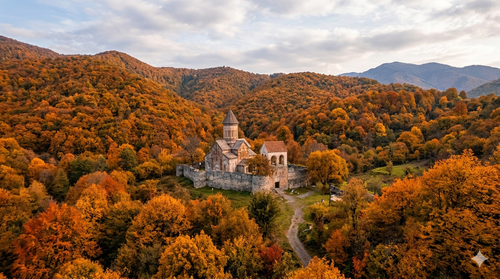
Here, Georgian, Azerbaijani, Armenian, and Greek cultural traditions have coexisted for centuries.
Remains of the earliest humans outside of Africa have been discovered in Dmanisi, one of the oldest Christian churches in the world stands in Bolnisi, and the Pitareti Monastery is hidden in the forests of the Trialeti Highlands.
The region's six municipalities offer a completely different, unexpected Georgia.
Bolnisi is home to the 5th-century Bolnisi Sioni Church, one of the oldest Christian churches in the world.
This is where the Georgian alphabet was first recorded.
Around it are 19th-century German colonies and vineyards.
Gardabani is located near the border with Azerbaijan.
It is home to a large Azerbaijani community that preserves its language and traditions.
Around it are the steppes of the Iori Lowland and the banks of the Kura River.
Dmanisi is the site of a sensational discovery: the remains of the earliest human found outside Africa, dating back 1.8 million years, were discovered here.
The medieval fortress town of Dmanisi stands at the confluence of two rivers.
A must-see place for anyone interested in the history of humankind.
Marneuli is the municipality with the largest Azerbaijani population in Georgia.
Fertile plains, orchards and vegetable gardens, and lively bazaars define the area.
Despite its proximity to Tbilisi, a completely different culture can be felt here.
Tetritskaro lies on the volcanic Trialeti Plateau.
The 13th-century Pitareti Monastery hidden in the forest is one of the most beautiful in Georgia.
Around it are quiet mountain roads, pastures, and silence.
Tsalka Municipality is a unique corner of Georgia with a Greek population that settled here as early as the 19th century.
Tsalka Reservoir, mountain landscapes, and Greek villages with whitewashed churches create a distinctive atmosphere.
This municipality is interesting for those who want to see a rare combination of Caucasian nature, Greek heritage, and peaceful rural life.
💬 The region includes seven administrative units: the self-governing city of Rustavi and six municipalities—Bolnisi, Gardabani, Dmanisi, Marneuli, Tetritskaro, and Tsalka. Kvemo Kartli borders Armenia and Azerbaijan to the south, making it one of Georgia's most multinational regions—Georgians, Armenians, and Azerbaijanis live here.
💬 In 1991, during excavations in Dmanisi, body parts of a man and a woman dating back 1.8 million years were discovered—after Africa, these are the oldest preserved human remains in the world; they were named Zezva and Mzia. It's best to get there from Tbilisi by car—officially, it's only 85 km; there's a museum-reserve on site, right on the excavation site with the ruins of a medieval settlement.
💬 The Bolnisi Sioni Church is the oldest surviving church in Georgia, built in the late 5th century (478–495). It is unlike typical Georgian churches—a squat basilica with three naves and cruciform columns, each with a unique design. Nearby, in the village of Tanjiani, is the museum of the 17th-century Georgian diplomat Prince Orbeliani, with 300 exhibits—paintings, sculptures, documents, and archaeological artifacts.
💬 Tsalka is an area once inhabited by Pontic Greeks, almost all of whom moved to their historical homeland 20–30 years ago. Today, abandoned Greek villages and ancient Orthodox churches with unusual architecture can be seen here. The region boasts a diverse landscape—from semi-desert steppes to forests and mountain lakes; the Mtkvari, Khrami, and Algeti rivers create ideal conditions for nature tourism.
💬 The Birtvisi Canyons are a unique natural landmark in Georgia, boasting sheer cliffs and picturesque views. Nearby is the Samshvilde Fortress, with the ruins of the Samshvilde Zion, located above a deep canyon. Admission to most historical sites in the region is free or costs around 3 lari—all points of interest are marked with special signs indicating the distance to the site.