




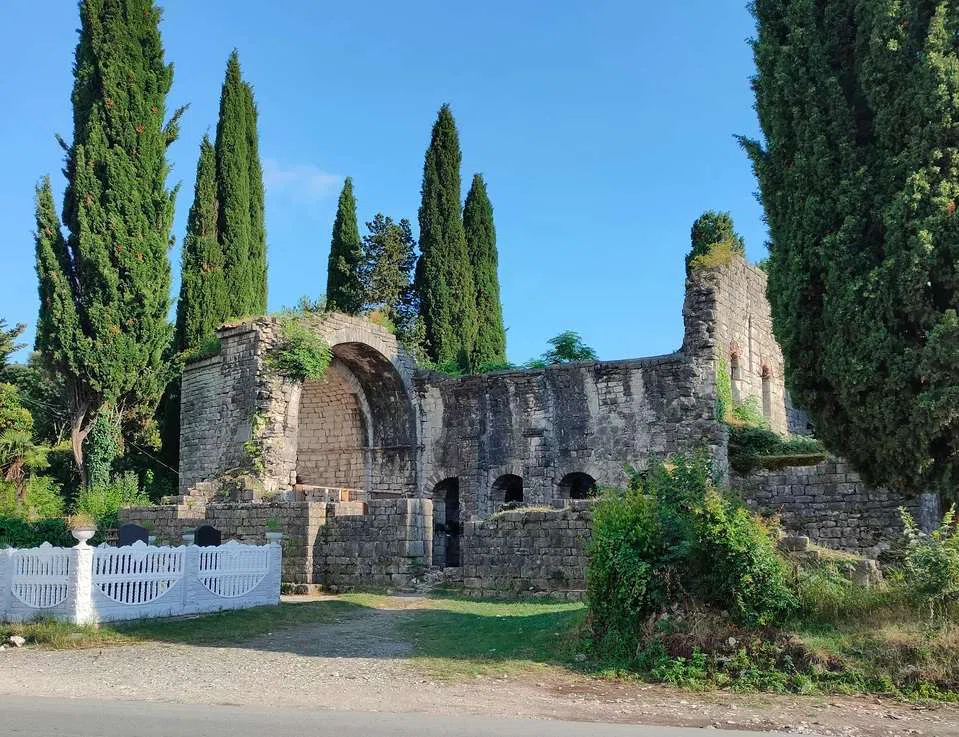
Temple in Tsandripsh: secrets of the unique Tsandripsh basilica that shock historians
The Tsandrypsh Basilica is one of the most mysterious and unique sights of Abkhazia. Learn about its ancient history, architecture, and how to get to this Byzantine temple that hides many secrets! Immerse yourself in the atmosphere of a sacred place with ancient tombs and historical artifacts. Be sure to visit!
📌 What will this article reveal to you?
- ✨ Unique facts about the 6th century temple
- 🧱 Unusual architecture with a baptistery and a tomb
- 🔍 Archaeological finds: marble, Greek inscriptions, amphoras
- 🧭 How to find the basilica and not pass by
- 🌿 Why Tsandripsh still remains a place of silence and strength
- 💬 Frequently asked questions + personal view
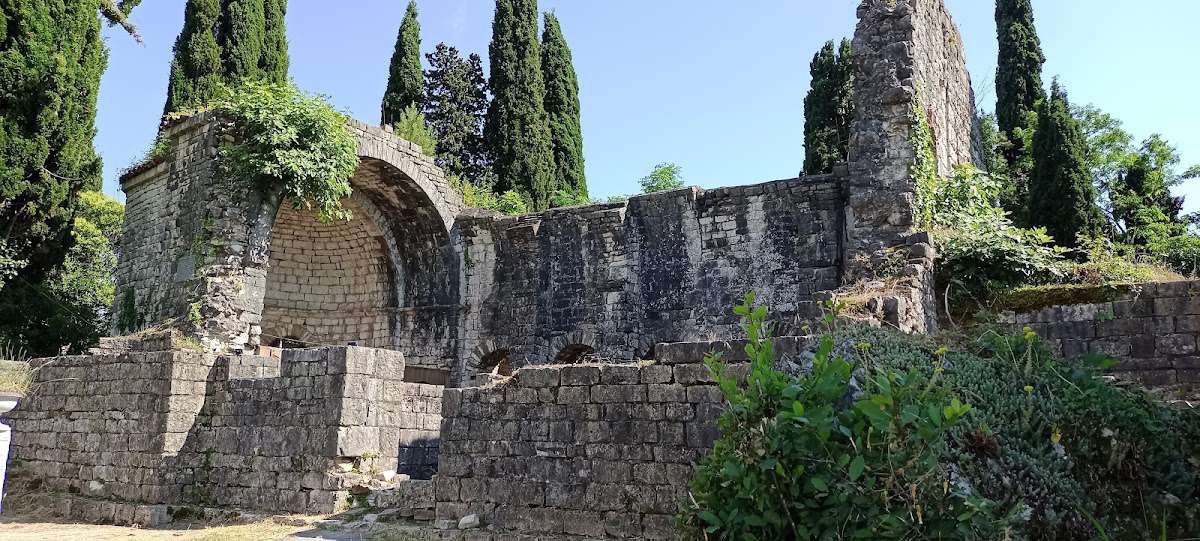
📜 History of the Tsandripsh Basilica: from Justinian to the present day
"Built among palm trees and mountains, it has survived emperors, wars, desolation - and remained. Because it was originally built to be eternal."
⛪ Tsandripsh Temple, also known as Gantiada Cathedral, or Tsandripsh Basilica (also known as Gantiada Basilica or განთიადის ტაძარი (in Georgian tradition)) is one of the most ancient and significant temples in the South Caucasus. This majestic monument was erected in the first half of the 6th century, and many historians accurately indicate the date: 534–543 AD, during the reign of the Byzantine Emperor Justinian I.
📜 According to Procopius of Caesarea, it was Justinian who ordered the construction of the temple for the Abazg people, who had just adopted Christianity. This version is supported by both the architectural features and the artifacts from the era of Justinian found at the excavation site.
He not only strengthened Orthodoxy as a state religion, but also laid down architectural standards that would be admired for centuries. The Temple in Tsandripsh is probably one of such projects. After all, it uses the rarest Proconnesian marble — a material whose extraction and transportation was personally controlled by the imperial family.
To build such a temple on the outskirts of the empire means to recognize this place as special. Perhaps there was an important Christian mission or even a bishop's residence here.
📍 Why here? In the 6th century, the village of Tsandripsh (then the capital of the vanished state of Sanigia) was an important strategic and religious center. The temple became not only a symbol of Christianity, but also a powerful political support for Byzantium on the Black Sea coast.
🏛 Unique feature: for the first time in Abkhazia, the church combined liturgical and memorial functions - here they simultaneously baptized and venerated holy relics.
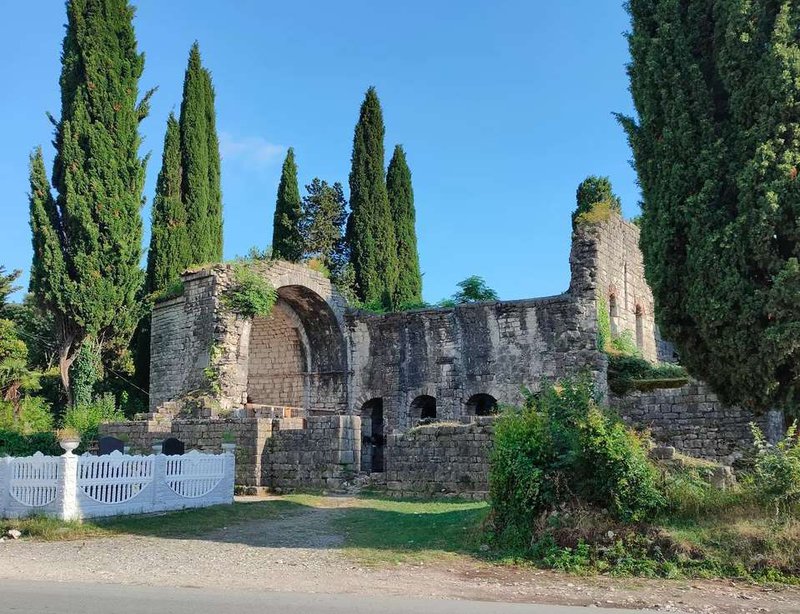
🕯 The fate of the temple: how the appearance of the shrine changed
- 6th century — the temple was built as a three-apse basilica with a baptistery and a tomb.
- 8th–9th centuries — reconstruction begins: the portico is removed, vaults appear, the structure of the walls changes.
- 10th–11th centuries — a new narthex, a portico at the southern entrance, re-laying of floors, addition of decorative elements.
- 16th century — after the Byzantine decline and conquests, the temple again serves as a place of worship.
- Soviet period — a semi-abandoned state, but services continue.
- Today — the temple is open, services are held, the territory is maintained by believers.
Tsandripsh was not just a church for a long time, but also the episcopal see of the Abazgs. Some historians identify it with the temple described by Procopius of Caesarea in his work "War with the Goths" as built by Justinian specifically for the Abazg people.
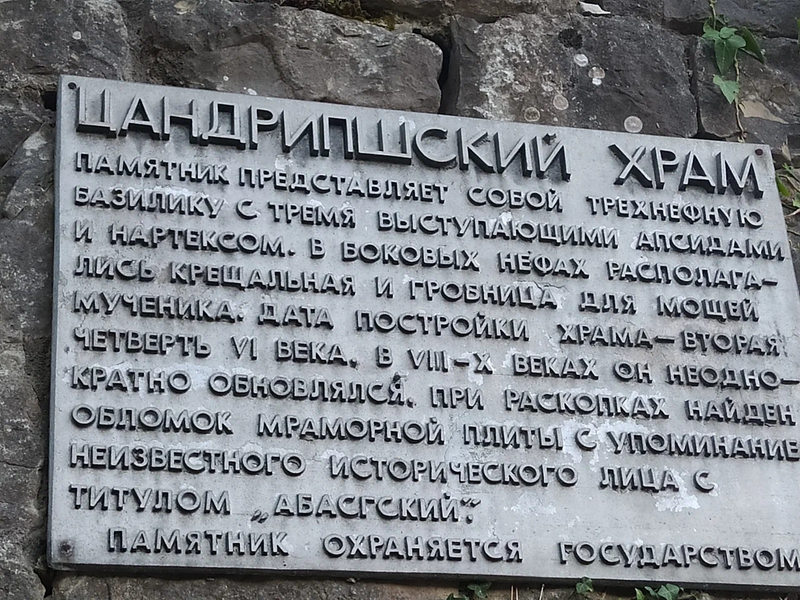
⚱️ Burials and Shrines: Memory Carved in Stone
In the southern part of the basilica, archaeologists discovered two tombs made of sandstone and limestone slabs. One of them, with a niche for the head and a table at the head, may have belonged to a martyr or a bishop.
On both sides are benches for worshipers, which indicates regular pilgrimages to these tombs.
🔎 In the central nave, there are 13 more burials, some of which were destroyed during reconstruction. All are oriented with their heads to the west, which is typical for Christian rites.
Archaeologists have found glass vessels, amphorae, and flasks, possibly containing incense or holy water. Some tombs were reused in the Middle Ages.
The relics that were supposedly kept in the main tomb have not survived. But the holiness of the place is still felt. Believers come here to ask for healing, and the church still serves as a place of spiritual remembrance for the entire region.
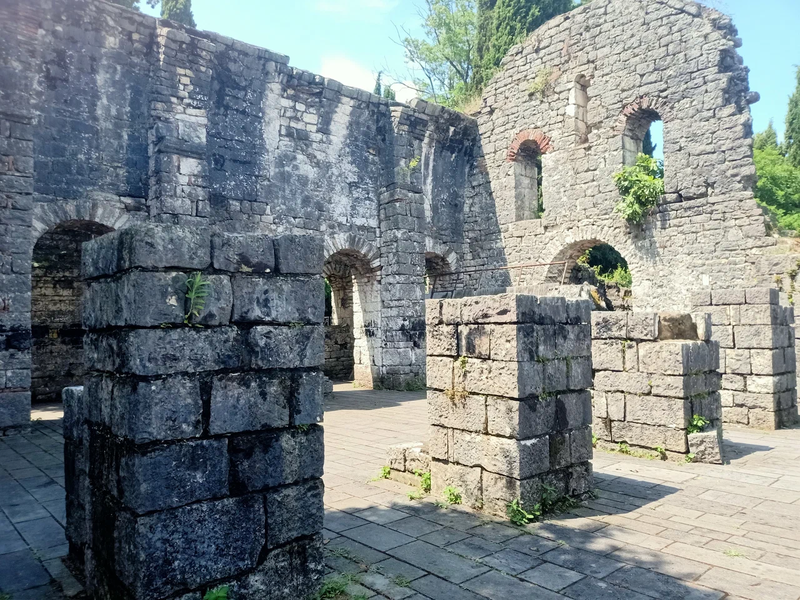
🧱 Architecture: Byzantine harmony of stone and light
“There is no gold in this basilica, but there is a restrained power and architectural clarity that is understandable even after one and a half thousand years.”
If you think that all early Christian churches in the Caucasus are the same, the Tsandripsh Basilica will change your mind. It is not just ancient, it is unique in its layout and combination of architectural techniques. Neither Abkhazia, nor Eastern Georgia, nor Asia Minor has a temple with such a configuration and semantic load.
The Tsandripsh Basilica is not just ruins, but an architectural code of the Justinian era, encrypted in stone. At first glance, it is modest remains of walls in the shade of palm trees. But if you look more closely, we see one of the most technically complex and well-thought-out structures of the Byzantine era in the entire Caucasus.
📐 Layout and scale
The temple is a three-aisled, three-apse basilica with a narthex and a portico. The overall dimensions are about 27.5 × 16.8 m, which makes it the largest early Christian temple in Abkhazia.
- The central apse is pushed forward, with an altar and bema.
- The northern apse is a baptistery, with a unique font in the form of a trifolium.
- The southern apse is a memorial chapel with two tombs.
- Inside there are 15 burials, most without inventory, but strictly according to the Christian rite.
- The church had no windows in the upper tier → more of a pseudo-basilica than a classical one.
🧭 Note: such functionally zoned basilicas are rare even in Byzantium. Usually, tombs and fonts were located outside the temple. Here, everything is inside.
💡 An interesting feature: if you remove the apses and narthex, the plan of the temple is almost square - this is rare for basilicas.
🗺️ Scheme of the original plan of the Tsandripsh basilica - to better imagine the structure of the ancient temple

🧱 Design features
🏗 Initially, the temple had a wooden roof, later covered with stone vaults (VIII-IX centuries). To support them, new pilasters were added, partly directly on the tombs of the central nave.
🧱 The walls are made of hewn limestone, plastered inside. The floor is paved with lime mortar.
🏛 Elements of the façade plasticity have also been preserved: arched openings, decorative columns, marble fragments.
📌 Curiously, the altar part with the bema was not originally connected to the side naves - the liturgical space was strictly separated.
🏗 Architectural details
- The central apse is pentagonal, projecting forward, with a bema
- The side apses are semicircular, located asymmetrically
- The narthex and vestibule are the western part, with the remains of a portico and entrances
- The baptistery (north nave) has a font and a separate entrance
- The memorial chapel (south nave) has two tombs, an altar table and benches
"There is no gloss here - but there is depth. The Tsandripsh basilica sounds like a muffled prayer, in stone, shadow and architecture."

📿 Interior decoration and atmosphere: the graceful severity of early Christianity
In Tsandrypsh you will not see gold and gilded iconostases. Here beauty is in the honesty of the stone, in the line of the arch, in the touch of time. Even in ruins the temple continues to "sound" - and it sounds not loudly, but dull and deep, like a prayer in the twilight.
🔦 What's left inside
- 🧱 The apse and bema have almost completely survived. The central apse is pentagonal, with a high vault, above which traces of amphorae walled up in the masonry are still visible (this made the construction easier).
- ⚰️ Two tombs - inside the southern nave, near the altar. They were considered sacred, and according to legend, one of them belongs to the holy martyr.
- 🛁 The baptistery - with a trefoil-shaped font. Located in the northern nave. Its dimensions indicate an early period, when infant baptism was just beginning to supplant the rite of full immersion.
- 🕯 The altar partition was made of wood and stone, the remains of the foundation are still visible. According to the reconstruction, a marble cross and royal doors hung above it.
"When I first entered this temple, it wasn't the interior that greeted me - it was the silence. This is not a tourist place. This is a point of presence. History is not told here - it is felt."
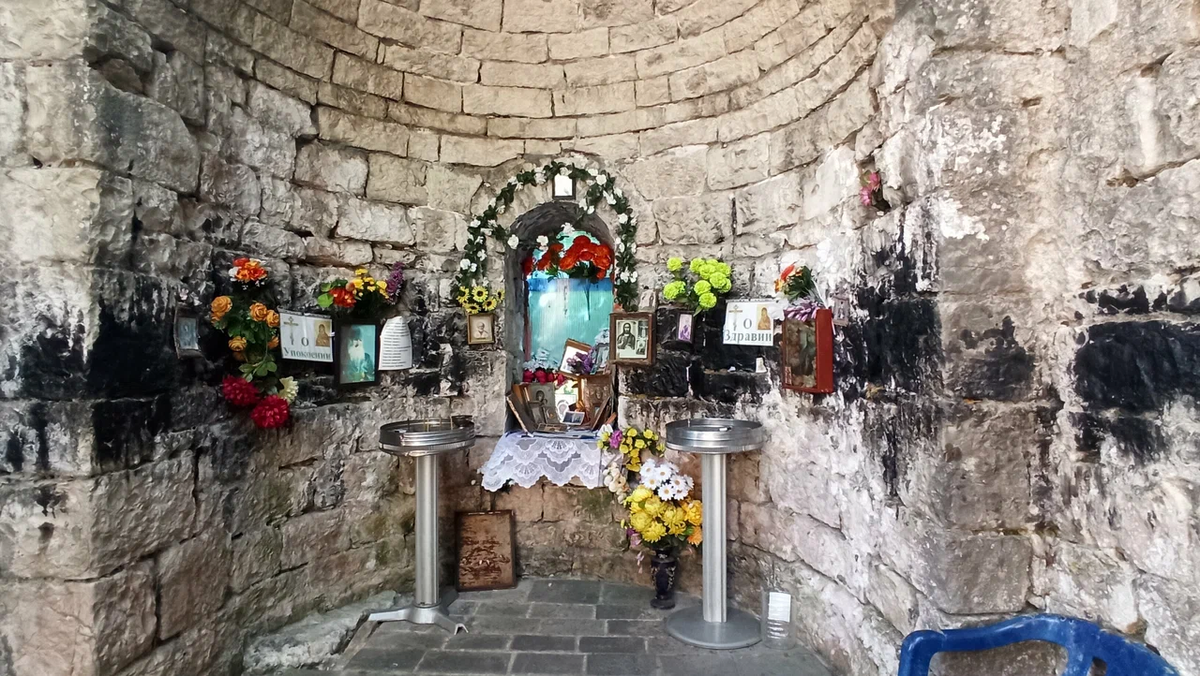
🔔 Today
The temple is open to visitors. Several times a month, a priest from Gagra comes here to conduct a service. There are almost no tourists - it is quiet and secluded here, and this is what makes the atmosphere especially valuable.
🙏 Please remember: the temple is located in a cemetery. Be respectful and do not disturb the peace of this holy place.
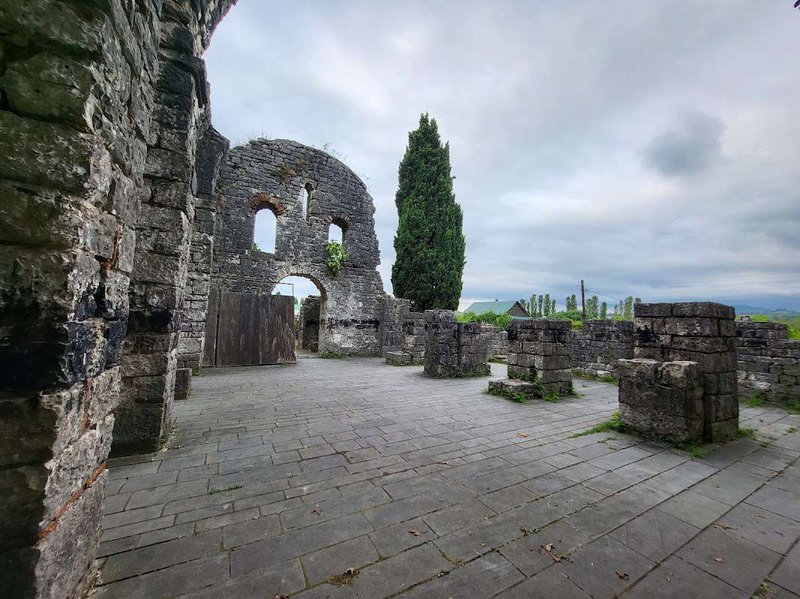
🏺 Archaeological finds: treasures under a layer of centuries
If you were here in the 20th century, among the weeds and stones washed away by the rain, it would hardly occur to you that under your feet is one of the richest archaeological layers of Abkhazia.
The Tsandripsh Basilica kept its secrets for centuries - until archaeologists began excavations in the 1970s.
🔍 What did scientists find?
- More than 130 skeletons dating back to different eras — from early Christianity to the 18th–19th centuries
- 70+ fragments of marble decor — columns, panels, ornaments
- Greek inscriptions, including epitaphs and references to Abazgia
- A scattering of artifacts — glass bottles, ceramics, Byzantine amphorae, bronze objects
Many of these finds are now kept in museums in Sukhum and Tbilisi. But several fragments still lie in the grass near the temple - if you look closely, you can see carvings or grooves from inscriptions.
🏺 Ceramics, glass, metal
- Amphoras of the 12th–13th centuries — white engobe, massive handles, graffiti
- Pithoi of the 9th–10th centuries — large vessels for storing oil or wine
- Venetian glass of the 14th–15th centuries — elegant bottles made of the finest glass
- Persian vessels of the 17th–18th centuries — with a spherical body, green and brown
- Metal objects: keys, knives, thimbles, crosses, sabres of the 18th century
🧱 Marble from Proconnesus
Particular attention was drawn to the marble used in the decoration of the basilica. This stone was mined exclusively in the imperial quarries on the island of Proconnesus (modern Marmara). Its use meant one thing: patronage of the Byzantine court.
Some fragments were found stacked upside down, apparently reused during reconstruction. One of them served as… an ordinary step.
💬 Amazing little things
- 🏛 Fragment of marble with the inscription "ABAZGSKY" - probably from a tomb
- 🪧 Stone slab at the altar with the inscription "19" - possibly a mark of the master about the completion of the work
- 🧪 Glass vessels at the headboards - as offerings to the dead or relics of saints
These findings paint a three-dimensional picture: Tsandripsh was not just a temple. It was a living spiritual center where people lived, prayed, buried, and passed on cultural heritage from generation to generation.
🧳 Tourist information
🚗 How to get there
📍 Geolocation and coordinates
- Address: Republic of Abkhazia, Tsandrypsh village, Oktyabrskaya street
- GPS coordinates: 43.379415948303475, 40.07091749897474
- From Gagra: ~17 km, 15–20 minutes by car
- From the border with Russia (Psou): 10 km, ~10 minutes by car
🛣️ Route options
🚘 On by car
- The most convenient way
- From Sochi / Adler - through the Psou checkpoint, then along the sea to the south
- From Gagra - along the main highway, turn onto st. Oktiabrskaya
- Parking: there is no special one, but you can leave your car near the nearest houses — the street is quiet
🚌 Public transport
- Regular minibuses and buses from Gagra, Sukhum
- Also available after crossing the border with the Russian Federation
- Stop: get off at the central stop Tsandrypsha
- From there to the temple - ~5 minutes walk
🚶 On foot
- If you are already in the village - it is easy to get there from anywhere
- From the main square - just 1 minute
- From the bridge over the Lapsta River - ~580 m to the east
🧭 How can you not pass by?
- The temple is located behind the cemetery and is not visible from the road
- The main landmark is Oktyabrskaya Street, all transport goes along it
- It is better to use a navigator with exact coordinates
- If you are confused, ask the locals: "Where is the old church?"
💡 Tip: if you rent a car, you can easily plan the route "Gagra - Tsandrypsh - Pitsunda - New Athos" in one day. This is a real route of a pilgrim, architect and explorer all rolled into one.
When entering from Russia, it is most convenient to cross the border through Adler/Veseloye. There are fewer queues, and the route is picturesque.
🏖 Comfort, food and accommodation: how to stay in Tsandrypsh with comfort
🧳 If you decide not to just drop by the temple for an hour, but to really feel the spirit of the ancient Black Sea village, the best solution is to stay here for at least one night.
💡 Advice: in high season (July–August), it is better to book accommodation in advance. But in spring and autumn, you can choose something on the spot, without rushing.
🍽 Where to eat
- 🥟 B Tsandrypshe — simple seasonal cafes with home cooking: shashlik, khachapuri, corn, lemonade. There is no restaurant luxury here, but there is a warm atmosphere and real tastes of local dishes.
- 🛍 Next to the temple — village shops where you can buy bread, cheese, lobiani, fruits and water — a great idea for a picnic.
- 🍷 In Gagra — 15-20 minutes by car: choice from traditional taverns to modern cafes. Pkhali, wine and European cuisine with a sea view and evening music.
🏡 Where to stay
- 🏘 In Tsandrypsh there are cozy guest houses and mini-hotels with clean rooms, shady courtyards and silence. Some are located a couple of minutes from the basilica, which is convenient for those who like morning walks.
- 🏨 In Gagra, the choice is wider: from inexpensive apartments to hotels with breakfast and a view of the beach. Many options with a pool, kitchen, parking and transfer from the border.
Although the temple itself is already a powerful reason for a visit, the surrounding area of Tsandrypsh is a whole kaleidoscope of historical and natural discoveries.


On the outskirts of Tsandrypsh you can find points with stunning views of the coast, especially at sunset. The views open up from the hills above Gagarin Street - paths from local houses lead there.
👀 Useful tips
✅ Clothing: modest. Shoulders and knees are covered, preferably without beach paraphernalia. Women - a headscarf.
✅ Shoes: comfortable, with thick soles. The area may be unkempt, especially after rain.
✅ Bring: water, a flashlight (if you plan to explore the inner niches), a camera without a flash, a headscarf or hat.
✅ With children: yes, but explain in advance that the temple is a place of respect and silence.
✅ Donations: there is a donation box next to the entrance. Support this place at least symbolically - every ruble (or lari) goes to its preservation.
❤️ My personal impression
I arrived in Tsandrypsh by chance, just following the coast. The navigator showed an "ancient temple", and I decided to stop. I didn't expect anything special. But when I went inside, I froze.
No tourists. Just stone, wind, a light smell of grass and walls that are one and a half thousand years old. And silence. The kind you won’t hear in the city. I stood inside, where children were once baptized, where people prayed over tombs, and it seemed to me that I could feel the breath of those who built this temple.
📖 This is not a landmark. This is a living organism. Not a museum, but a memory space. Not an Instagram location, but a point of power.
If you are close to the real, unhurried Georgia - even in its Abkhazian part - you definitely need to come here. Just don't forget to turn off the sound on your phone. It is not needed here.
🏁 Why is it worth coming here?
The Tsandrypsh Basilica is not just an ancient church in an abandoned garden. It is a place of power, memory and deep architectural meaning, where everything from the Greek inscriptions to the shape of the font speaks of a great past.
- 📚 The first Abazgian episcopal see was once located on the territory.
⚱️ Inside are tombs revered as saints.
The marble of Proconnesus, permitted only by the will of the Byzantine emperor, still retains the elegance of its era.
🧭 In no other basilica in the entire Caucasus will you find such a combination of styles, functions and cultural codes.
🕯 It is not history that sounds here - it is silence that sounds here. And this silence is sacred.
💬 If you have already been here, tell us in the comments what you felt. And if you haven't yet, save this article and be sure to include the temple in your route.
📌 Share this article with those who are looking for the real thing - not gloss, but depth. Let the Tsandrypsh Basilica be revealed to the world anew.
❓ Frequently asked questions
- Can I enter the temple?
Yes. Admission is free. The Tsandripsh Basilica is an active temple, although without a permanent congregation. Be respectful: do not make noise, do not leave trash, do not enter in beachwear. - When is the best time to come?
Spring and early autumn are ideal. Greenery, comfortable temperature, minimum tourists. In summer it is too hot, in winter it can rain, and the temple area will become difficult to pass. - How can I find out if there will be a service?
There is no regular schedule, but several times a month the priest comes from Gagra. Local residents can sometimes tell you the exact dates. - Can I take photos?
Yes, but without a flash, especially during the service. And please, no staged photo sessions in front of the altar - this is a holy place. - Are there cafes and accommodations nearby?
Yes. In Tsandripsh itself, there is a minimum, but in Gagra (only 15-20 minutes) there is a large selection of both restaurants and hotels. - Can the temple be confused with the Katskhi pillar?
No, these are different objects. The Tsandripsh basilica is in Abkhazia, and the Katskhi pillar is in Imereti, Georgia. However, confusion does occur, especially for those who are exploring the region for the first time.


21 comments
Log in to leave a comment