





Don't miss: the most unusual monastery in Georgia that almost no one knows about - Katskhi
Discover the Monastery of the Nativity of Christ in Katskhi, a unique chrysanthemum-domed church hidden in Imereti. Find out how to get there, what's nearby, and why this place is unmissable. Add to your itinerary now!
🧭 What will you learn from this article?
📍 Find out what a chrysanthemum-domed church is and why it is so unique for Georgian architecture.
🚴️ How to get to the monastery and what to pay attention to on the road.
🍽 Where to have a snack along the way.
🔮 The history and spiritual significance of the Katskhi church.
🏛 What's inside: architectural details, shrines and interesting features.
🗺 What else to see nearby.
📌 My personal impressions
🏛 A little history - and you immediately fall in love
As a person who has visited dozens of churches throughout Georgia, I can say with confidence: the Monastery of the Nativity of Christ in Katskhi is not just an architectural monument, but a silent chronicle of a millennium, carved into stone.
⛪ It was built at the very beginning of the 11th century, approximately between 988 and 1014, not by the kings, but by the Baghvashi princes - a noble family that ceded the Kldekari fortress to King Bagrat III and moved to Imereti. The temple was conceived as a family tomb, but became much more - a symbol of the spiritual and cultural center of the entire region.
📜 It was a time of architectural searches and bold decisions. The architects could have been inspired by the temples of Kvetera, Bochorma, Ninotsminda, perhaps even Zvartnots or the lost basilica of Bana - but the final embodiment turned out to be absolutely original, monumental and proud in the Georgian way.
🧭 The temple is located in the village of Katskhi, just a few kilometers from the city of Chiatura. It is often confused with the temple on the Katskhi pillar, but it is important: these are two different buildings, and it is the Monastery of the Nativity of Christ that is an architectural phenomenon.
🛠 After its heyday in the 11th century, the monastery was abandoned for a long time. Only in the 16th century did Prince Abulasar Amirejibi restore it, giving it new life. In the 20th century, desolation came again, and only in the 2000s did restoration work begin: the foundation was strengthened, the galleries were cleared, but the upper part of the building remained intact - in front of you stands the original of the 11th century.
🏰 Despite its dilapidation, the temple has not lost its sacredness. It is still in operation today - people serve here, pray, and in the silence of the Georgian mountains the ringing of the bell is heard, as if sounding through the centuries.
🧱 Architectural phenomenon: the christian temple
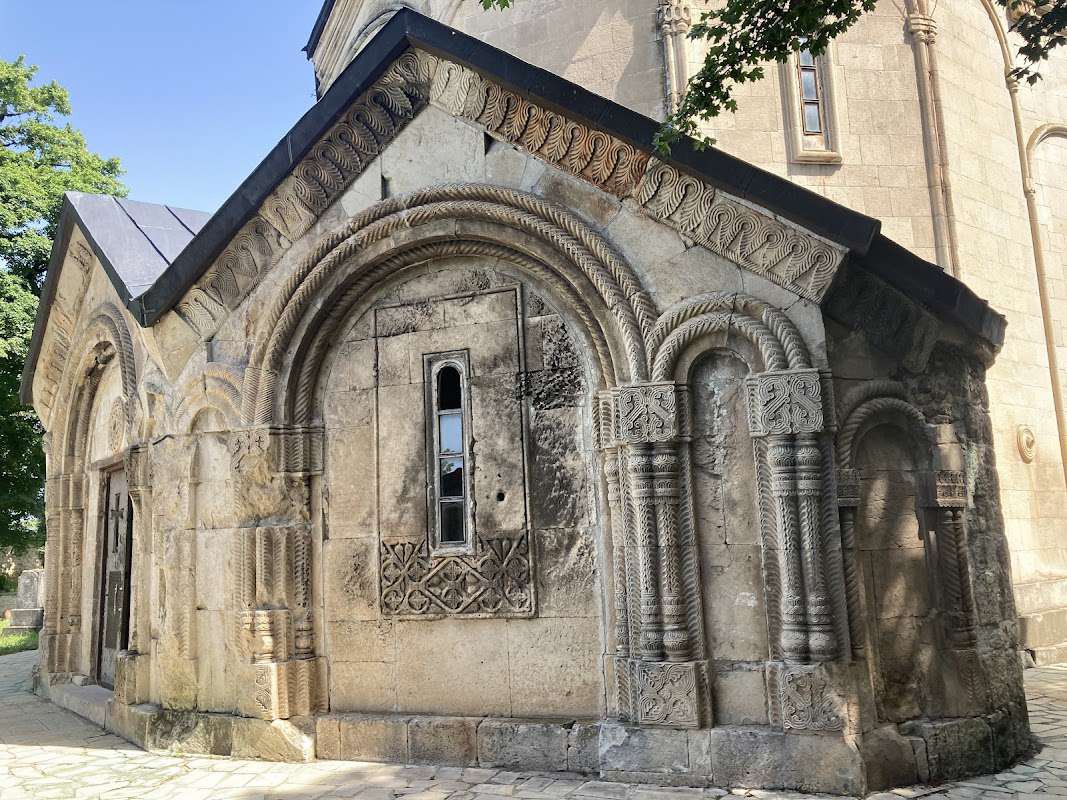
📐 The Monastery of the Nativity of Christ in Katskhi is a unique example of chrysmo-dome architecture, which has no analogues in Georgia. The basis of the plan is a six-pointed cross (Chrism), inscribed in an almost round (octagonal) shape with six apses surrounding the central space. All of them are connected by an ambulatory - a covered bypass gallery, which gives the temple a special rhythm.
🏛 The temple consists of three vertical levels:
- the lower one is a bypass gallery,
- the middle one is the main hall with the altar part,
- the upper one is the drum and the dome.
☂️ The dome is a real sensation. It is the so-called umbrella dome, not conical or pyramidal, but like a petal flower opening to the sky. For Georgian architecture, this is almost a unique case, more typical for the Armenian tradition. There is a version that this is the only temple in the entire Caucasus with this type of roof.
The internal trompe l'oeil — semicircular passages between the arches and the dome — are already symbolic here. They do not perform a supporting function and mark the end of an entire architectural era in Georgia.
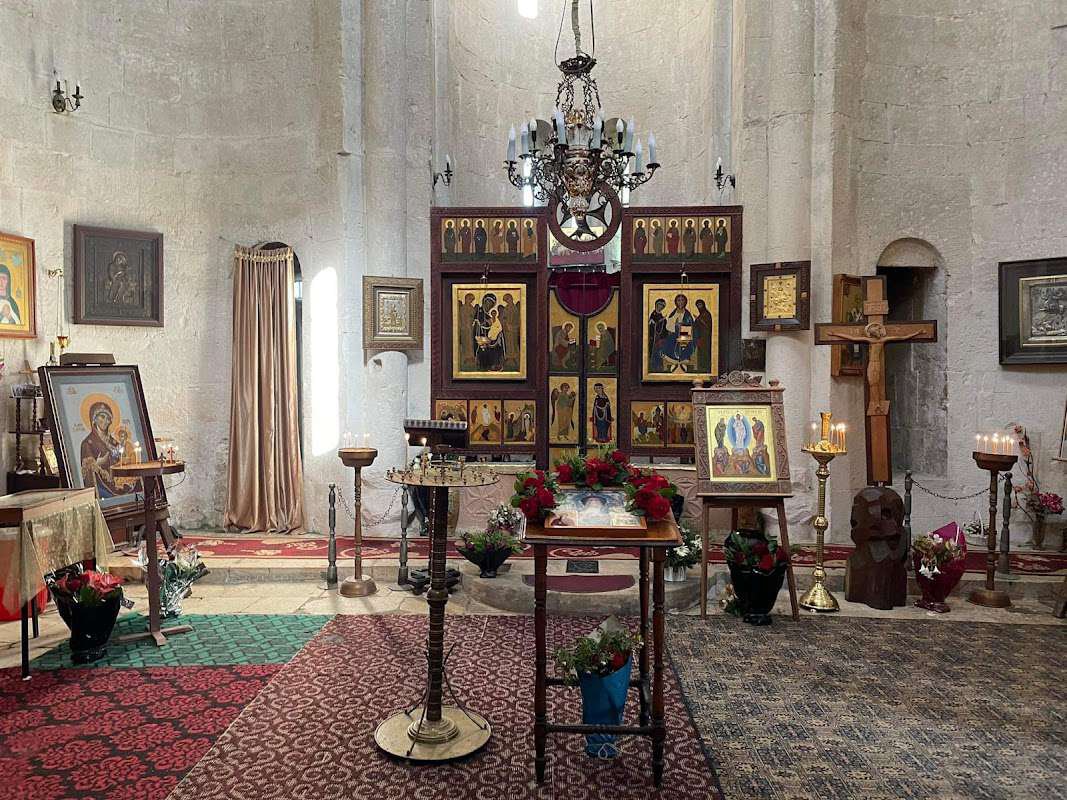
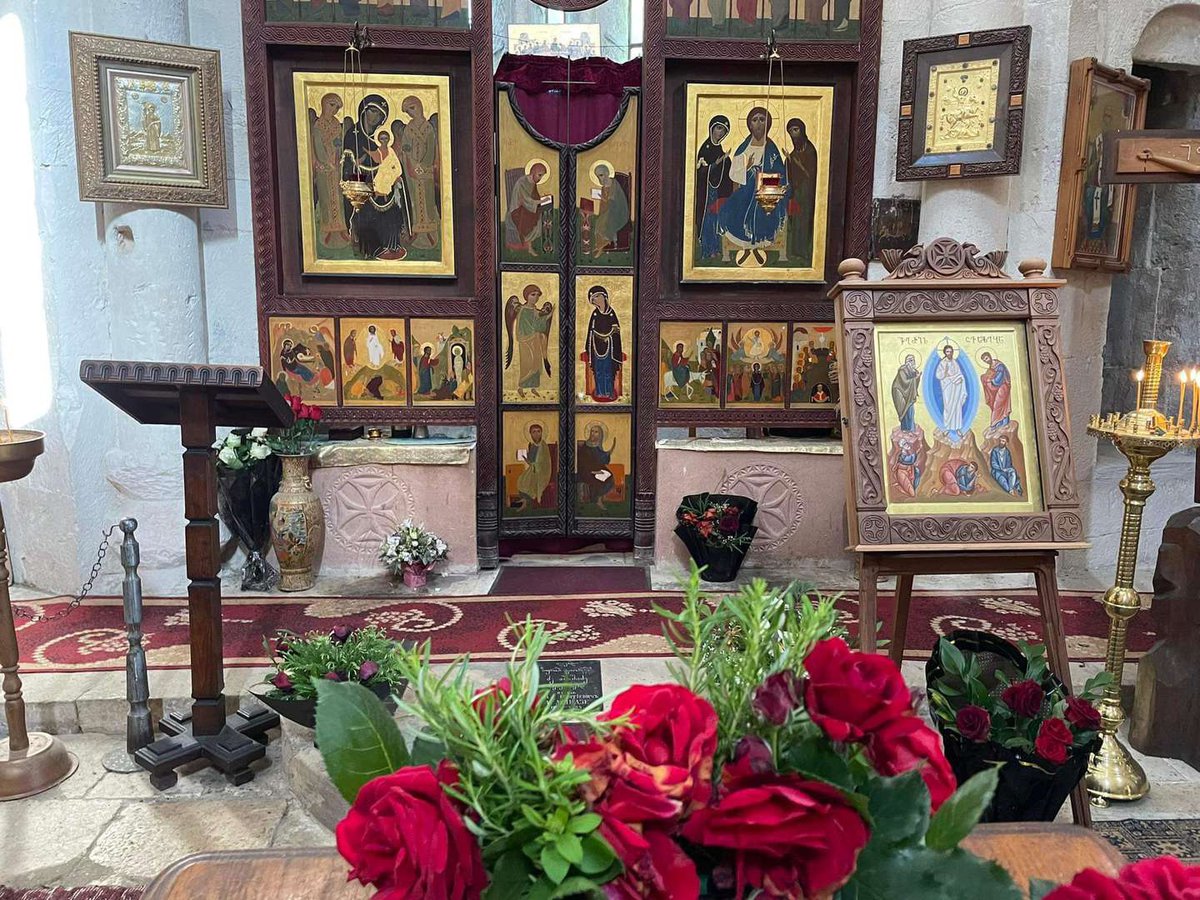
⛪ The altar part is striking in its sophistication: a partition without columns, with a narrow passage and three tiers of icons (including a rare lower and upper one). Such a solution is practically not found in other Georgian churches.
🎨 The southern gallery is decorated with the relief "Exaltation of the Holy Cross", where angels support the cross. According to legend, it once held a piece of the Life-Giving Tree. The northern gallery is closed, probably due to dilapidation.
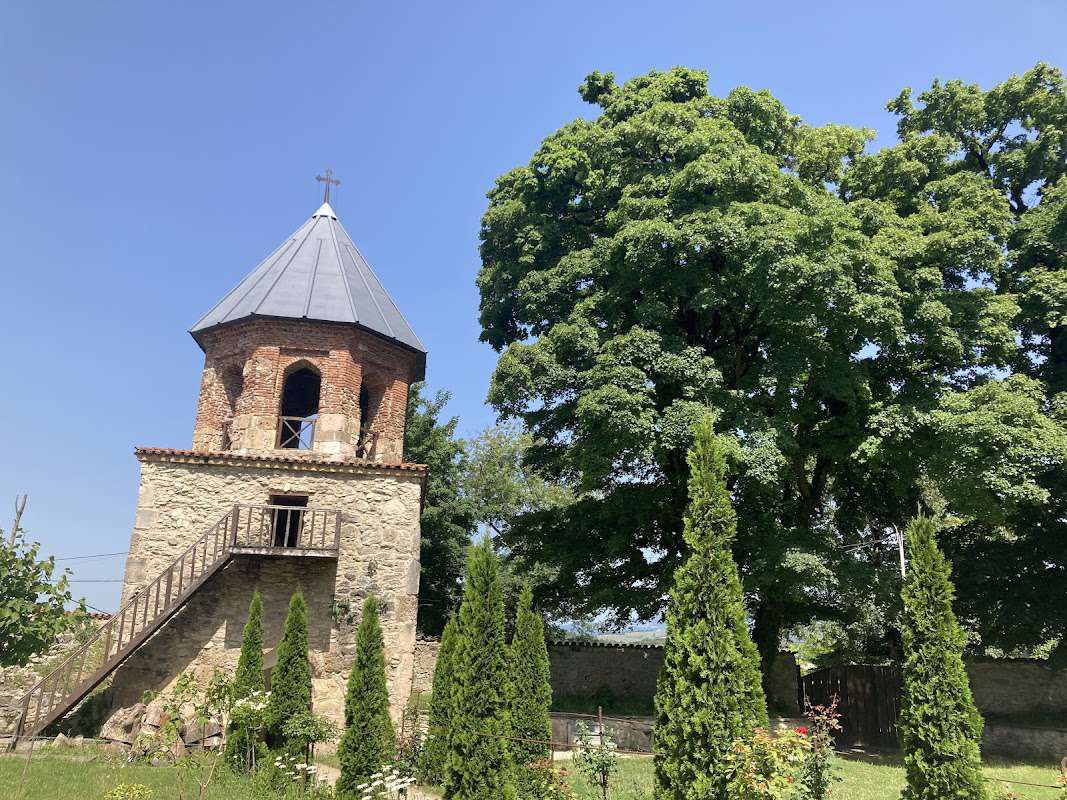
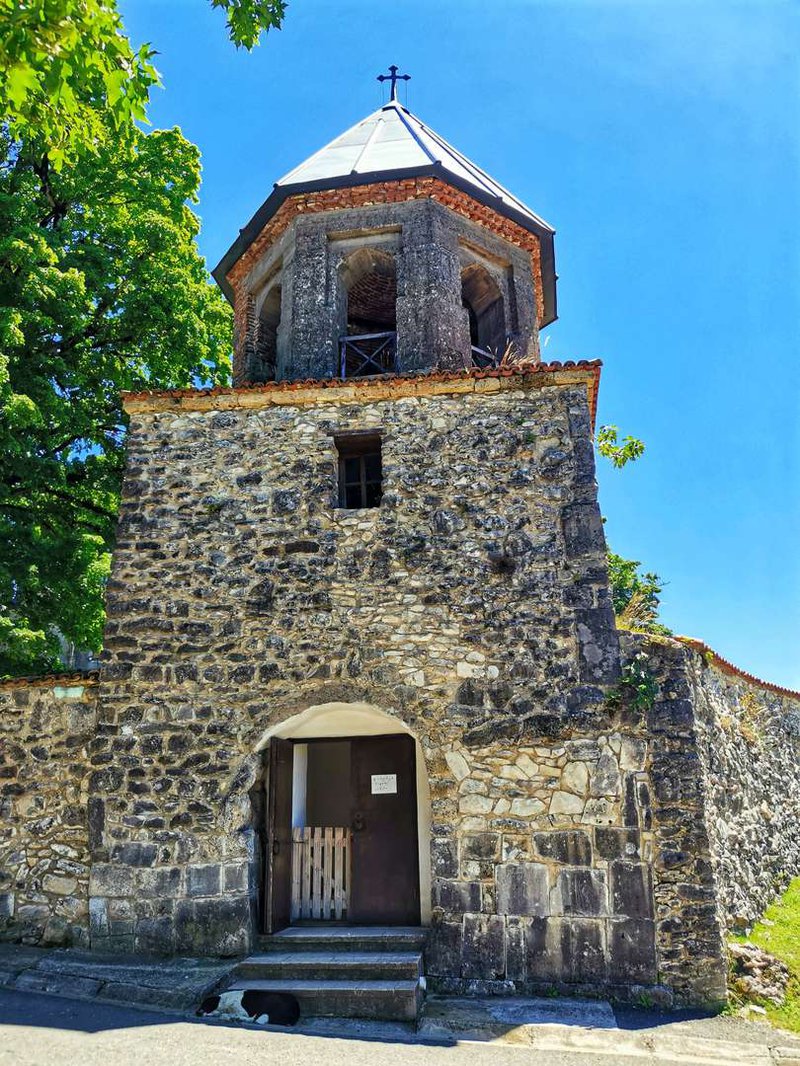
🏰 The entire building is surrounded by a stone wall, and at the entrance there is a bell tower with pointed arches, typical of the architecture of the 17th-18th centuries. Despite the simplicity of the forms, the temple looks monumental and integral, while maintaining the intimacy and chamberliness of the interior space.
🕯 Services are still held in the temple, especially on holidays. Despite the modesty of the decoration, it remains a living spiritual center, surrounded by silence and respect.
📿 Interior decoration and atmosphere
Entering the Church of the Nativity of Christ in Katskhi, you feel like you are stepping over the boundary of time. There is no gold, paintings or sparkling domes here. There is bare stone, semi-darkness, the breath of antiquity and the feeling that the walls remember everything.
🕯 Light penetrates through narrow windows and softly glides along the stone arches. The tromps - once the most important element of temple architecture - play only a decorative role here, but they cast thin, almost living shadows on the walls. This is architecture in which shadows speak no less than forms.
⛪ The altar is modest but elegant, like the temple itself. It is separated by a partition without columns, with a narrow entrance, behind which are three tiers of icons: a rarity even by the standards of the Georgian church. Everything is extremely simple - but in this simplicity one can feel the depth and reverence.
🎨 The most expressive is the bas-relief in the southern gallery: the scene of the Exaltation of the Cross, where four angels hold the crucifix. This is almost all that remains of the original sculptural decoration, but it is enough to stop, freeze and listen to the stone.
📖 The rest is ascetic and honest: hewn walls, traces of time, the absence of excess. This is what gives the place a special sacred purity. Every crack here is like a wrinkle on the face of an old man whom you want to listen to in silence.
🔔 Above the entrance is a small bell tower with arches from the late period (17th–18th centuries). Today it looks old, but cozy in its own way: as a symbol of the fact that the temple is still alive.
🙏 The temple is open to everyone. Services are still held here, especially on the day of the Nativity of Christ, to which it is dedicated. You can just come in, light a candle, sit in silence or talk to a monk - they always respond with warmth and respect.
✨ This is not a tourist attraction. This is a place of power that accepts without asking and does not let go right away.
🕰 Interesting facts and legends
📜 The Monastery of the Nativity of Christ in Katskhi is shrouded in mystery, architectural guesses and oral traditions that are carefully passed down from monks to pilgrims. It is believed that its shape was inspired by the lost Temple of Bana, a Byzantine masterpiece in the Tao region, which is known only from fragmentary information. Some researchers also find similarities with the Armenian Zvartnots, but this similarity is most likely accidental - a reflection of the general era of architectural experiments in the Caucasus at that time.
📚 According to Georgian historians, the temple in Katskhi became the "last chord" of early medieval church architecture. It was here, as if in farewell, that tromps were used - an architectural element without which no domed structure of the 5th-10th centuries could do. After Katskhi, their era ended.
🧱 During restoration work in the 2000s, fragments of inscriptions in asomtavruli, the oldest of the three forms of Georgian writing, were found in the walls of the monastery. Carved tombstones were also discovered, presumably belonging to the Bagvashi family. One of them, according to local legend, belongs to the founder of the temple - although archaeologists have not yet confirmed this with documents.
🌟 Mystical legends are also associated with the temple. One of them concerns the relief in the southern gallery: a scene of the Exaltation of the Cross, where four angels hold a crucifix. According to legend, this cross once kept a piece of the Life-Giving Tree, brought to Georgia by pilgrims from the East. Today, the icon is lost, but the energy of the relief, as the monks say, is still “alive” - and many believe that prayer here brings healing.
📖 Another local belief says that the relics that disappeared during the raids are invisibly buried in the wall of the southern apse, but their invisible presence is felt by everyone who comes to the temple with an open heart.
📚 Quotes from historians
"The Church of the Nativity of Christ in Katskhi is an architectural experiment of extraordinary boldness. This type of construction is not repeated anywhere else." - Akaki Sulakauri, art historian
"The Katskhi Monastery is a silent witness to the beginning of national unification. It was built not by a king, but by a noble family - and this is its human strength." - Nino Tsereteli, cultural scientist.
🏺 Historical clarifications and rare information
📍 The Church of the Nativity of Christ is located in the gorge of the Katskhura River, in the village of Katskhi, Chiatura Municipality. According to an alternative version, it was built in 1032 by King Bagrat IV Kurapalat and his wife Elena, the niece of the Byzantine Emperor Romanos Argyris.
⚔️ At various times, the temple was a family church and a crypt for various feudal houses, including the Bagvashi family and later the Abashidze family. It is here that Liparit IV Bagvashi, one of the most influential feudal lords in the history of Georgia (died in 1064), is buried.
📚 Katskhi Monastery was an important cultural center: scribes worked here, a rich library was kept, theological and literary works were carried out. Among the unique relics:
- "Katskhis Gulani" - a collection of theological texts, rewritten by order of Giorgi-Malaki Abashidze;
- Translation of the Gospel of Matthew (1059), made by Ekvtime Atonel on leather;
- Gilded icon of St. George the Victorious and a large icon of Christ, associated with the eristavi of Racha.
🦁 At the entrance to the temple there are figures of a lion and the so-called “old angel”, symbolically indicating the connection with Baghvashi.
🪨 The temple was completely decorated with stone carvings, but in 1854 it underwent an unsuccessful "restoration", as a result of which many decorative elements were lost or painted over. The scene of the ascension of the cross by four angels, a unique bas-relief on the terrace, was also damaged - it was doused with white paint. In the courtyard there is a monumental bas-relief of a lion, presumably removed from the wall and moved.
🔤 Above many entrances to the temple you can see inscriptions made in the asomtavruli font. Some of them are shortened - the "dakaragmebuli" style was used, in which vowels were omitted.
🎨 Fragments of the iconostasis and relics from the temple are now kept in the State Museum of Art of Georgia.
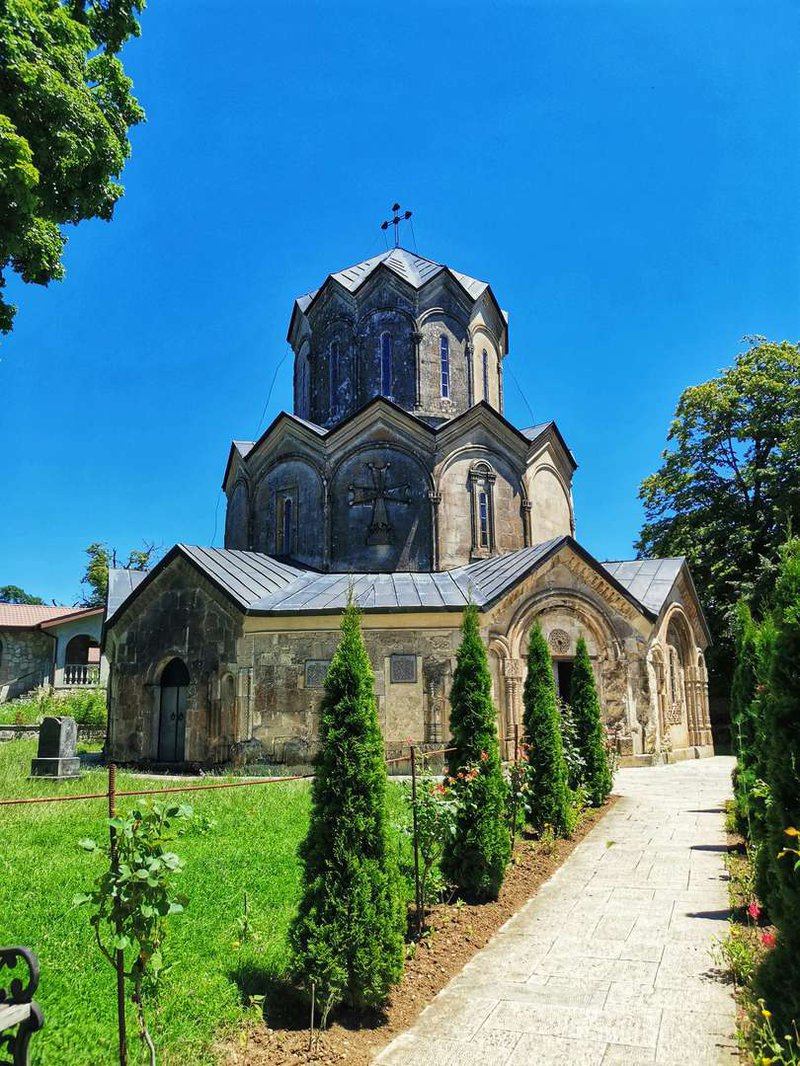
📜 What happened to the temple after a thousand years"
The history of the monastery in Katskhi is not just a series of dates. It is the life of the temple, filled with ups, silence, destruction and the miracle of return.
- 11th century — built by the Baghvashi clan as a family tomb, a symbol of power and spirituality
- 12th–14th centuries — experiencing gradual decline and desolation
- 16th century — restored by Prince Abulasar Amirejibi, the temple is again filled with prayers
- Soviet era — closed, abandoned, forgotten
- 2000s — partial restoration began: the foundation was strengthened, the galleries were cleaned, conservation was carried out. The most amazing thing is that the drum and dome have been preserved in their original 11th century form
🔍 During the restoration, fragments of inscriptions in Asomtavruli, the oldest Georgian script, and tombstones, presumably belonging to representatives of the Bagvashi clan, were found.
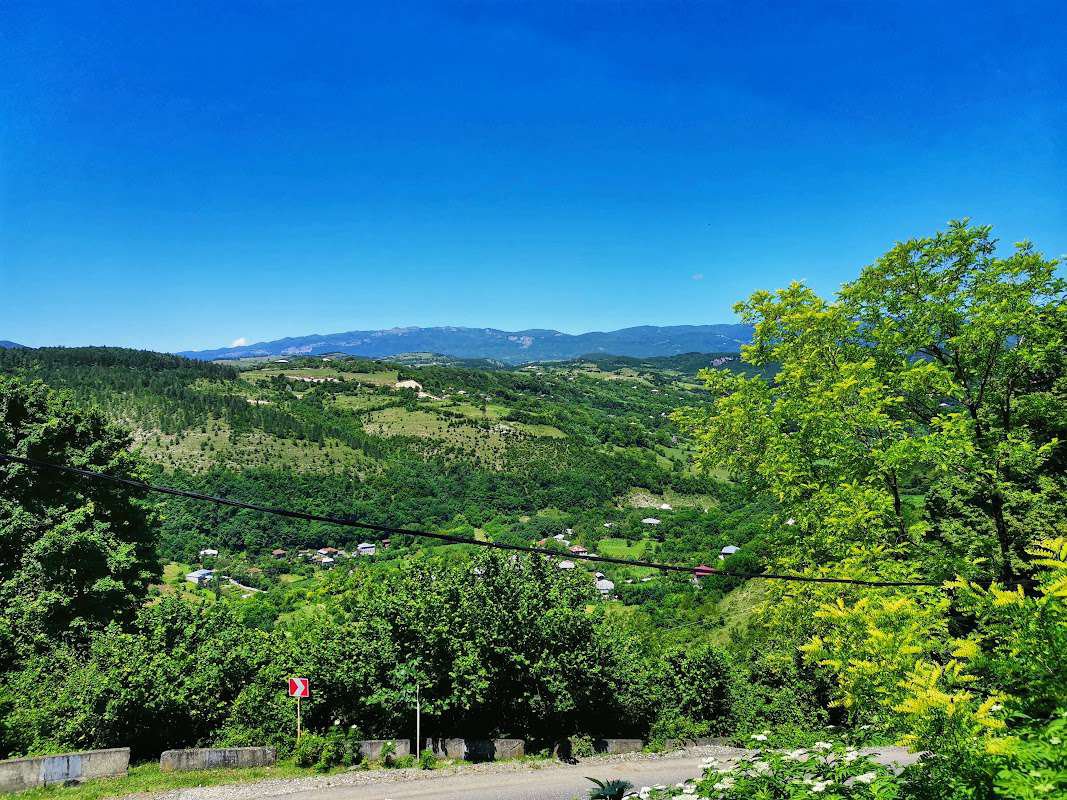
🚗 How to get there
📍 Finding the monastery is very easy. It is located on the highway, in the village of Katskhi (Imereti region), about 40 km from Zestafoni, on the way to Chiatura.
🗺 If you are traveling by car from Tbilisi:
- Travel time: 3.5–4 hours
- Drive along the E60 highway through Zestafoni, focus on the turnoff to Chiatura
- In the village of Katskhi, you will first see the Katskhi pillar (on the right), and a kilometer later, the monastery, on the left side of the road
- GPS coordinates:
42.26951891216374, 43.21305147445099
🚘 You can leave your car on the side of the road - the monastery is clearly visible, it's hard to miss
🚌 Public transport:
- From Tbilisi there are minibuses and buses to Chiatura
- From there - by taxi (~10-15 minutes) or on foot (~1 km)
- The walking trail to the monastery goes past a picturesque valley and opens up a view of the Katskhi pillar
🧭 Advice: if you are driving a rented car, be sure to stop by the Katskhi pillar, it is within walking distance from the monastery and will add to the experience.
🍽 Where to eat and relax
🥟 There are no cafes in the village of Katskhi itself, only a few village shops where you can buy bread, cheese, lobiani, water or lemonade. If you like the atmosphere of solitude, it is best to take a snack with you and have a picnic right next to the monastery wall. It will be both convenient and truly soulful. The main thing is to remember to clean up after yourself 🙏
🍲 I recommend having lunch in Chiatura - there are good cafes with traditional cuisine. Here are a few proven places:
- Café Paris — home-style traditional cuisine, cozy atmosphere
- Restaurant Rcheuli — a great place for a glass of wine or a slow food dinner
- Restaurant Gazapkhuli 2007 — if you want something hearty and Georgian: khinkali, kharcho, lobio and pkhali
☕ On the way, you can stop at small village shops - there you can buy water, pastries and sweets.
🧺 Lifehack: in the summer it is especially nice to take lobiani, grapes and mineral water with you, spread a blanket on the grass and have lunch with a view of the temple and mountains.
🔔 Spiritual meaning and cultural value
The Monastery of the Nativity of Christ in Katskhi is not just a temple made of stone. It is a stone of Georgian identity, a silent witness to the spiritual evolution of the people, an architectural metaphor for the transition from antiquity to maturity.
It is associated with the era of:
- 📖 The unification of Georgia under the rule of Bagrat III
- ✝️ Strengthening Orthodoxy as a support for the national spirit
- 🛡 Formation of a local aristocracy loyal not only to power, but also to faith
🎓 Today, the temple is included in regional cultural heritage protection programs, but remains almost unknown to the general public. Scientists consider it a key element in understanding the transitional period in Georgian temple architecture.
This place is not just for show. It is the point where history meets the present, and a silent stone speaks louder than any speech.
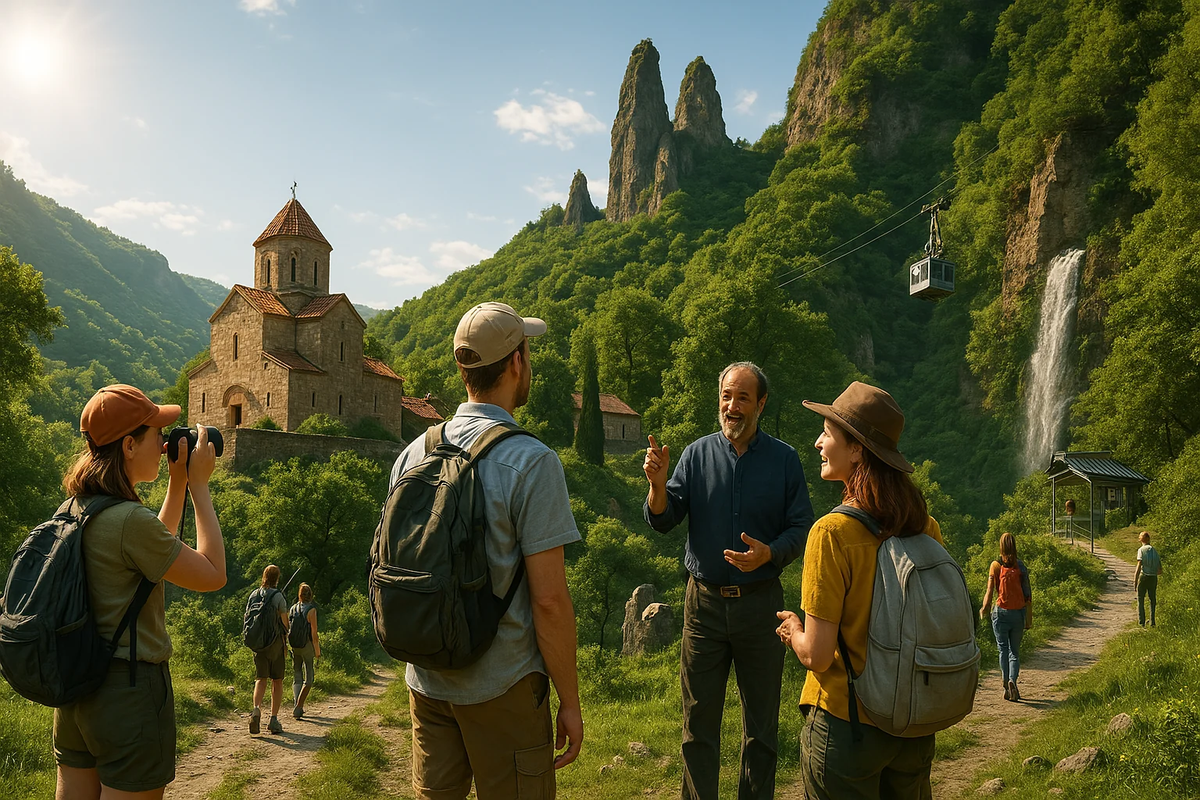
🗺 What else to see nearby?
📍 Even if you came only for the Katskhi Monastery, do not rush to leave. Within a 1-hour radius from here there are unique natural, architectural and cultural sites that will easily fit into your route.
👉 Katskhi pillar
Just 1 km from the monastery rises the famous 40-meter high pillar-cliff, on top of which is a church and a hermit's cell. Only monks can climb up there, but even from the ground this spectacle evokes awe.
📸 The best photos are taken at sunset, when the light “floods” the rock with gold.
👉 🚠 Chiatura cable cars
A symbol of Soviet engineering thought and still an operating "attraction" are the cable cars that locals use as transport. Each cabin is a retro cabin from the 60s that shakes, creaks, but still reliably delivers passengers through the gorges.
🎥 Be sure to take the ride at least once - it really is like traveling back in time.
👉 🏰 Gelati and Motsameta
Two classical monasteries of Imereti, located in the vicinity of Kutaisi (40-50 minutes drive from Katskhi).
- Gelati is an ancient academy where the best minds of medieval Georgia studied
- Motsameta - a monastery with a legend about martyred brothers and a view of a seething river
🌟 Both are UNESCO World Heritage Sites
👉 🌌 Prometheus Cave (Tskhaltubo)
If you love nature, stalactites, underground lakes and mysterious atmosphere - this is the perfect end to the day. The excursion includes lighting, walks and a boat part on the underground river.
🚗 You can get there in 50-60 minutes by car from Katskhi.
👉 🌄 Viewing platforms above the Katskhi gorge
Informal but gorgeous. They offer panoramic views of the valley, the temple and the pillar against the backdrop of the mountains. The best place to just stop, breathe – and remember this trip forever.
❤️ Personal impression
When I first came to Katskhi, there were no lines, no ticket offices, no people with selfie sticks. Only silence, wind, the smell of sun-warmed stone — and the grandeur of the temple, standing for a thousand years, as if outside of time.
I remember how the trompas cast thin shadows on the floor, and the candle in the altar barely illuminated the carving, leaving the feeling that everything around was living and breathing. Inside — no gold, no paintings. Only stone, silence and the feeling that you have entered a space where words are not needed to understand the main thing.
This place is not for tourists. It is for those who are looking for silence, authenticity, the present. Who are ready to turn off the route a little to find something more than just a beautiful shot for stories.
If you are tired of gloss, of extras, of the usual "must see" — just come to Katskhi. Sit by the wall, look at the sky and listen to the sound of silence. It will tell you more than any guidebook.
❓ Frequently asked questions
🔎 Is this the same church on the Katskhi pillar?
No. The Monastery of the Nativity of Christ is at the foot of the cliff, a kilometer below the pillar. They are often confused, but they are two different objects.
🚪 Is admission free?
Yes, free and without restrictions. The temple is open daily. It is important to behave respectfully and dress modestly (women should cover their heads).
📸 Can I take pictures inside?
Yes, without a flash and preferably outside of service hours. It is better to ask the ministers for permission first.
🧭 Are there any excursions?
There are no official ones. But monks or locals will be happy to tell you about the history of the temple if you approach them with respect.
🏨 Are there any hotels nearby?
In Katskhi itself - no. The nearest accommodation is in Chiatura and Kutaisi. You can also stay in private guest houses.
🗓 What season is best for the trip?
The best time is spring and autumn. Summer is hot, winter can be slippery and foggy.
💬 Have you been to Katskhi?
Share your impressions in the comments - and if you haven't been yet, save the article so you don't forget about this amazing place 🙌


20 comments
Log in to leave a comment