




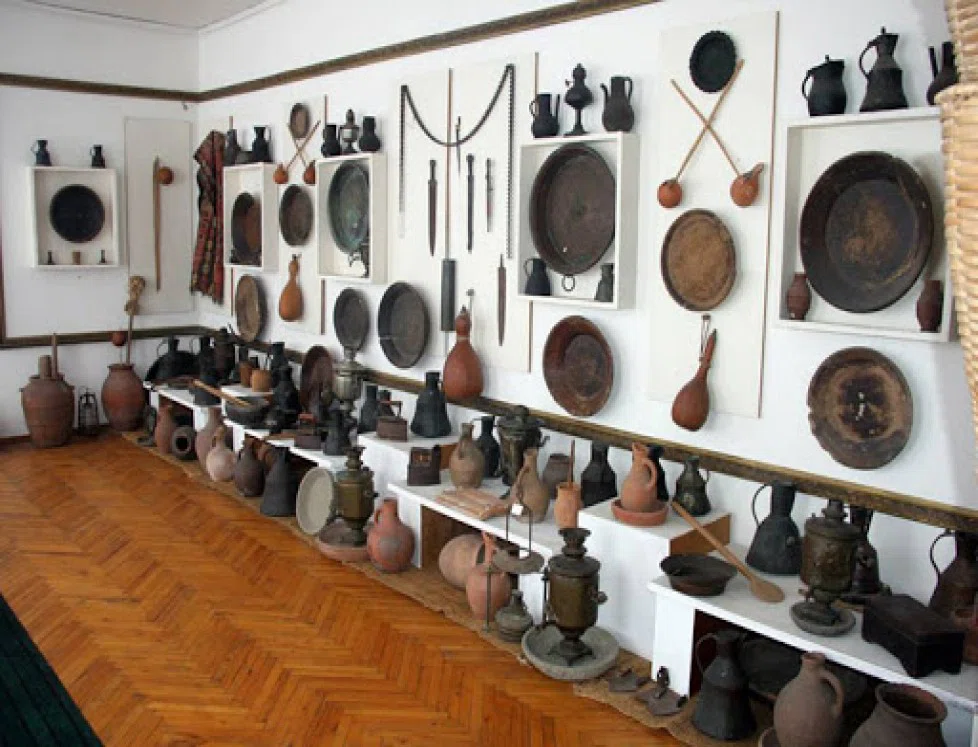
A good local history Museum of Georgia. Lanchkhuti Museum of Local Lore.
The Lanchhuti Archaeological Museum is an interesting museum where you can see the most ancient exhibits. Natural resources in the form of peat, oil, minerals, stone, ice and others are presented here. There are also artifacts from the Neolithic era. Be sure to visit this museum.
The Lanchkhuti Museum contains exhibits reflecting the natural, archaeological, ethnographic and historical aspects of the region's past. Natural fossils are represented by samples of peat, oil, minerals, flint, sandstone, limestone (with inclusions of flint, shells and malachite) and others.
Archaeological collections include Neolithic material (Dzhurkveti village); artefacts from the most ancient settlement of the Early Bronze Age – Cholipa (IV-III millennia BC); Colchian axes of the Late Bronze Age, hoes, spearheads, daggers, a vessel for spices and other imported clay pottery of the ancient era (Colchian culture of the II-I millennia BC), a bronze helmet (IV century, Dzhundzhuati village), a bronze bridle with an image of centaurs (V century, Chibati village) and other materials related to the early or late feudal era.
The ethnographic exposition is represented by folk art items and ethnographic materials characteristic of the region. A separate room is allocated for photos and documentary materials related to prominent families of Guria (Gurieli, Tavdgiridze, Machutadze, Shalikashvili, Tavartkiladze, etc.). Photographic material reflecting the travel and performances of Gurian riders in Europe and America, and others are also exhibited here.
Lanchkhuti Museum is a unique source of information about ancient times and the culture of Guria. The museum's exposition includes natural fossils that are important witnesses of the past. Among them are: peat, oil, minerals, stone, ice and other materials. The archaeological collections of the Lanchkhuti Museum contain valuable artifacts that testify to the ancient cultures and civilizations that existed in this area. One of the most interesting exhibits is the material dating back to the Neolithic era (the village of Dzhurkveti). Here are artifacts from the most ancient settlement of the Early Bronze Age - Cholipa (IV-III millennia BC). In the museum you will find Colchian axes of the late Bronze Age, hoes, spearheads, daggers, vessels for seasonings and other imported clay pottery of the ancient era (Colchian culture of the II-I millennia BC), a bronze helmet (IV century, the village of Dzhundzhuati), a bronze bridle with an image of centaurs (V century, the village of Chibati) and other materials related to the early or late feudal era. In addition, the museum presents materials reflecting folk art and ethnography of the region. A separate room is allocated for photos and documentary materials related to prominent families of Guria, such as Gurieli, Tavdgiridze, Machutadze, Shalikashvili, Tavartkiladze and others. In the museum you can learn about the traditions and customs of local residents, see folk costumes, jewelry, tools, crafts and ancient tools. The ethnographic exhibition of the Lanchkhuti Museum presents household items, clothing and jewelry, as well as crafts and activities that the region's residents were engaged in. Here you can see wooden chests, carpets, national clothes, jewelry made of silver, beads and stones, as well as handicrafts made of leather, ceramics and metal. Interestingly, among the exhibits there are even rare items such as hunting traps and tools used for survival in the wild. Another interesting part of the museum is the historical exhibition, which presents materials related to various historical periods. Here you can see weapons, military uniforms, household items, photographs and documents. Particular attention should be paid to materials related to the history of Georgia and the Samegrelo region. Here you can learn about famous Georgian kings such as Tamar and David IV the Builder, and about important events in Georgian history such as the war with the Ottoman Empire and the fight for independence. The Lanchkhuti Museum is also famous for its archaeological finds, which are kept in a special exhibition. Here you can see the remains of ancient animals and plants, as well as tools that were used by people in ancient times. In addition, the exhibition includes artifacts related to various historical periods, from the Neolithic era to the early or late feudal era.
One of the most valuable exhibits of the museum is a bronze helmet, which was found in the village of Dzhundjuati. The helmet dates back to the 4th century and is a rare example of military equipment made of bronze. It was found during archaeological excavations on the territory of the Cholipa fortress, located on a high hill near the town of Lanchkhuti. This helmet, made of bronze, is one of the earliest examples of bronze weapons in Georgia. It dates back to the 4th century BC and belongs to the Bronze Age. The helmet has an original shape, reminiscent of a maple leaf, and is decorated with engravings in the form of lines, circles and triangles. Not far from Lanchkhuti is the resort town of Borjomi, famous for its mineral springs. In Borjomi Park you can try Borjomi - carbonated mineral water, which is loved not only by residents of Georgia, but also by tourists from all over the world. In addition, the park has many interesting places to visit, such as the Borjomi Palace, built for the Russian Empress Catherine II, and the Vertlkhmesa cave monastery, founded in the 11th century.
Another interesting place to visit near Lanchkhuti is Katskheti, a famous wine region of Georgia. Here you will find many wineries where you can taste real Georgian wine and learn about the traditions of winemaking in Georgia.
It is also worth noting that Lanchkhuti is an important transport hub in the region. There is a railway station here, from where you can go to cities such as Tbilisi, Batumi, Kutaisi and others. In addition, several major highways pass through Lanchkhuti, connecting the city with other regions of Georgia. Thus, the Archaeological Museum in Lanchkhuti is not only an interesting place where you can see the most ancient exhibits, but also a place where you can immerse yourself in the rich history of Guria and learn more about its culture and folk art. For those interested in archeology, this museum is a real paradise. Here you can see samples of peat, oil, minerals, flint, sandstone, limestone (with inclusions of flint, shells and malachite) and other natural fossils. The museum's archaeological collections include Neolithic material (Jurkveti village), artifacts from the most ancient settlement of the Early Bronze Age - Cholipa (IV-III millennia BC), Colchian axes of the Late Bronze Age, hoes, spearheads, daggers, vessels for spices and other imported clay pottery of the ancient era (Colchian culture II-I millennia BC), a bronze helmet (IV century, Dzhundzhuati village), a bronze bridle with the image of centaurs (V century, Chibati village) and other materials related to the early or late feudal era. In addition, the museum presents a rich ethnographic exposition, where you can see folk art products and ethnographic materials characteristic of Guria. A separate room is allocated for photos and documentary materials related to prominent families of Guria, such as Gurieli, Tavdgiridze, Machutadze, Shalikashvili, Tavartkiladze and others. Photographic material reflecting the travel and performances of Gurian horsemen in Europe and America, as well as other interesting exhibits are also exhibited here.
--------------------------
We hope that you enjoyed our article about the Lanchkhuti Archaeological Museum. If you have any questions or comments, please do not hesitate to leave them below the article. We will be happy to answer your questions and discuss your thoughts. Your opinion is very important to us!


29 comments
Log in to leave a comment
артефакты из эпохи неолита. Природные ископаемые представлены из нефти,
кремния, известняка, малахита , минералов и песчаника, торфа.
Торф это осадочная горная рыхлая порода. Образуется в процессе естественного отмирания
болотных растений и неполного их распада в следствий нехватки кислорода и влажности.
Его применяют как горючее средство. Песчаник- это обломочная осадочная горная порода,
С последующей цементацией.
Археологические экспонаты это из эпохи неолита. Много античных предметов глиняных бронзовых.
Даже находили бронзовые уздечки с рисунками кентавров.
Материалы относящиеся к ранней и поздней феодальной эпохе.
В статье говорится что в музее этнографическая экспозиция характерная для этого края.
И здесь же выставлены фотоматериалы показывающие выступление Гурийских наездников.