



🧵 Khevsurian embroidery - cultural heritage of mountainous Georgia
📌 Briefly about the most important things
💰 Price Range: from 50 to 300 GEL
📍 Region: Khevsureti, Georgia
🧵 Uniqueness: handcrafted embroidery with sacred patterns
🌕 History: a tradition dating back to pre-Christian times
🍃 Materials: wool, natural fabrics, colored threads
📖 How this article will be useful
🧵 Khevsur embroidery is not just a decorative craft, but a living thread of generations that mothers pass on to their daughters in the highlands of Georgia.
🏔️ Each stitch contains the history of the people, each pattern contains a secret symbol that protects the home and family.
📜 In this article, you will learn:
- how the technique originated in the harsh mountains,
- what sacred patterns mean and how they were used in rituals,
- why Khevsur embroidery is considered a talisman, and not just decoration.
👗 Today, the tradition lives not only in museums: it can be seen in fashion collections, stage costumes and festivals. Khevsur craftswomen inspire designers and preserve the spirit of their ancestors in new forms.
📍 We will tell you where to find original products, how to distinguish genuine work from stylization and how to support those who carefully preserve this unique culture. ✨ Immerse yourself in embroidery, which is the whole philosophy of mountain Georgia - where every thread protects, and every ornament says more than words.
🥣 Origins and cultural context
🤎 Khevsurs are an ancient ethnographic group living in the highlands of northeastern Georgia, in the Khevsureti region. Their solitary way of life has preserved traditions in an authentic form for centuries, without external influence from other peoples
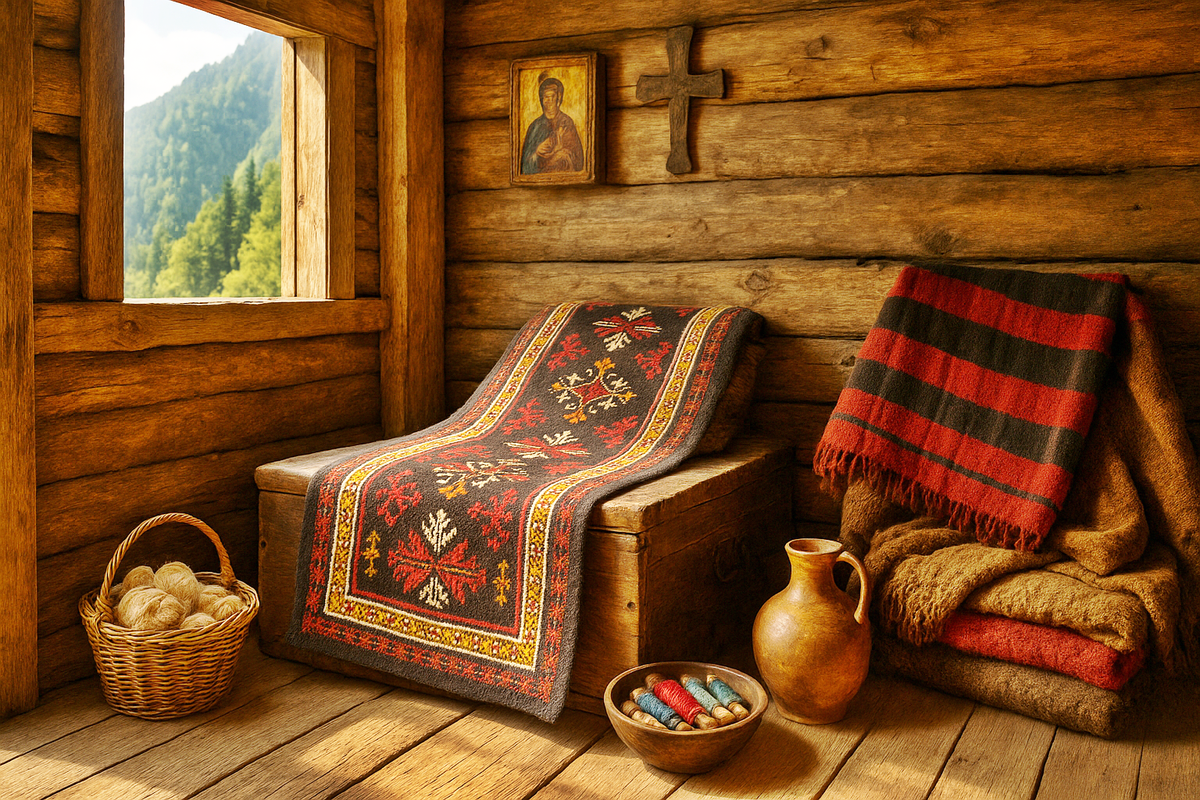
Embroidery among the Khevsurs is not just a decorative element, but a semantic and ritual code. Each ornament, each line in the pattern is a sign, a story, a protection, passed on with love and respect to the ancestors.
🎒 In the harsh conditions of the mountains, where dangers and challenges were everyday life, embroidered clothes served not only as decoration, but also as a talisman, a family identifier, and even a kind of identity passport.
🧵 The skill was passed down the female line, and every girl learned to embroider from her youth. Each village had its own colors, symbols and stitches - a kind of "visual language" that only the locals understood. Even everyday clothes often had protective elements hidden from prying eyes.
✨ Today, Khevsur embroidery is not only a memory of the past, but also a living cultural heritage that inspires designers, researchers and travelers from all over the world.
✂️ Ornaments and execution technique
Khevsur embroidery is not just a decorative element, but an art with deep roots, in which each stitch carries meaning. The work is always done by hand, according to a pre-created sketch, where the location, color and symbolism of each pattern are thought out.
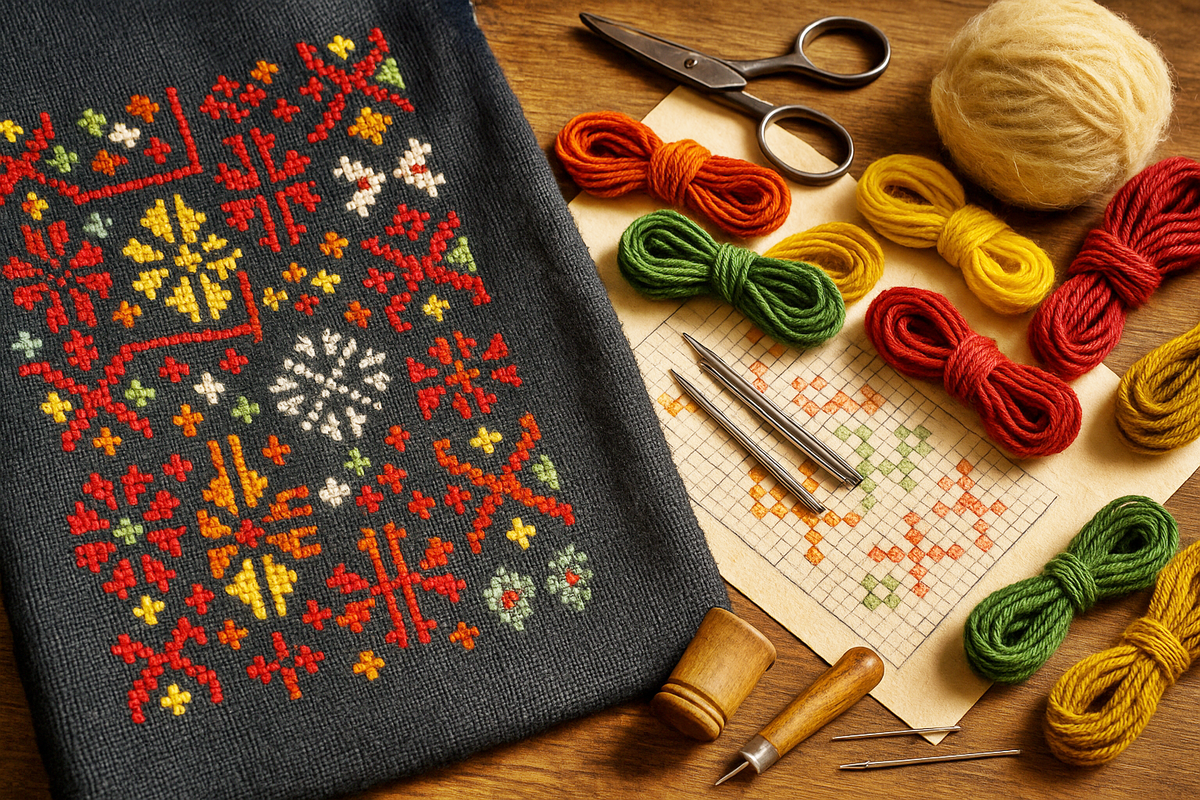
✂️ The main technique is a cross stitch, one of the most ancient types of stitches. Other techniques are also used: "chain stitch", "braid stitch", appliqués, sewn-in triangles and ribbons. Craftswomen often combine several techniques - for example, satin stitch is combined with geometric inserts, giving the product complexity and character.
🎨 The color palette is restrained, but incredibly expressive. The embroidery is created in dark red, green, ocher, blue, black and white shades. Each color has a sacred meaning:
🔴 red - life and blood,
🟢 green - rebirth,
⚪ white - purification,
⚫ black - protection.
🌈 Colors are not combined randomly - combinations are always filled with meaning and strictly follow traditional symbolism.
🔳 The patterns are geometric and precise: diamonds, stars, crosses, triangles, straight lines. They are placed symmetrically - on the chest, along the edges of the sleeves, on the hem, shoulders and headdresses. A special place is occupied by the central symbols:
✴️ eight-pointed star - a symbol of order and space,
👁️ "eye" - a talisman against evil,
☀️ solar circle - the power of the sun and life,
✝ cross with rays - balance and protection.
💫 Thanks to its severity and symbolism, Khevsur embroidery resembles a visual language in which clothing becomes a carrier of personal and family history. This is not just an ornament - it is a message encrypted in the threads of time.
🛡️ Symbolism and protection
🌟 Khevsur embroidery is first and foremost a talisman, not just a decorative element. Each pattern is a means of protection, a kind of shield that “seals” a person from external evil. In mountainous areas, where nature is harsh and the boundary between the spiritual and the physical is felt more acutely, embroidery served as a talisman against evil spirits, ill-wishers and troubles.
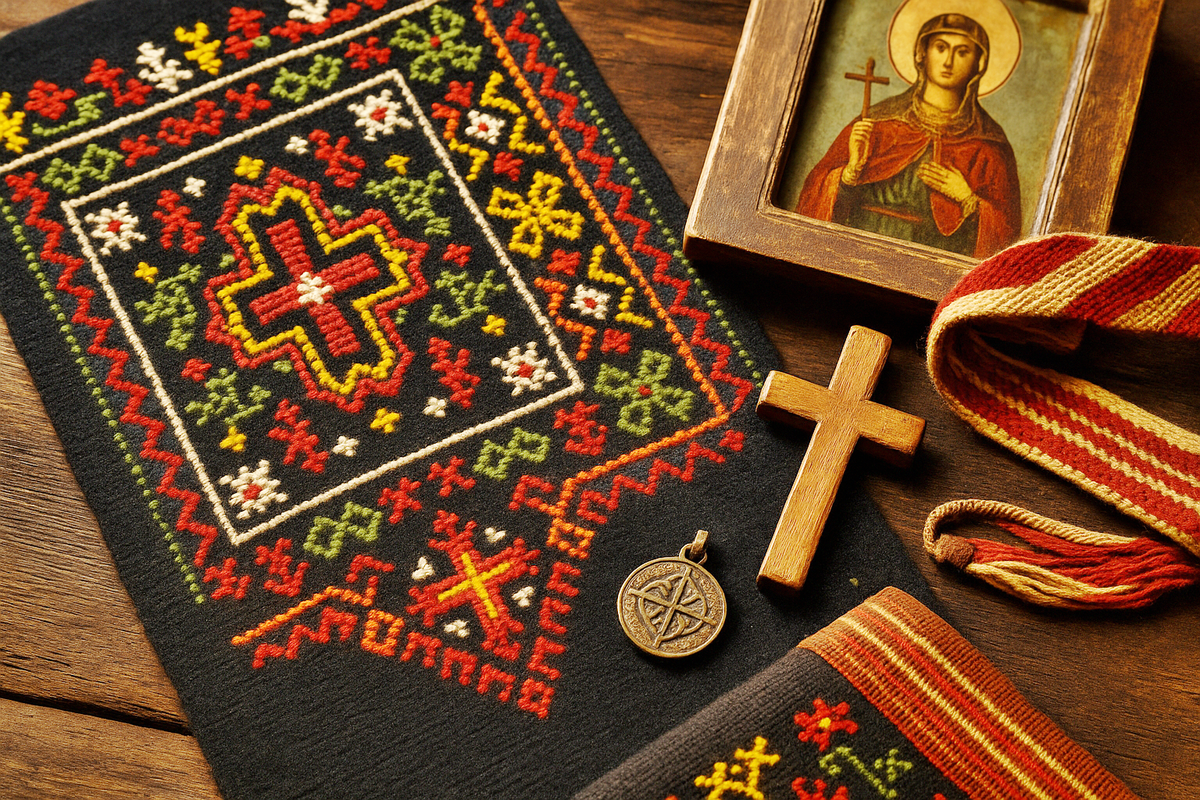
🛡️ Clothing with sacred symbols became something more than fabric and threads — it turned into a personal protective field, an energy shell, especially important for warriors, travelers and pregnant women.
⛪️ Many patterns go back to pre-Christian beliefs associated with the cult of the sun, earth and ancestors. However, after adopting Christianity, the Khevsurs did not reject the old, but wove crosses, symbols of faith, and signs of the Christian tradition into embroidery. 🌞 Such an interweaving of pagan symbolism with the new religion created a unique style, where ancient ideas about the world are harmoniously combined with Christian spirituality.
🪬 Patterns are a language accessible only to the initiated. Some motifs were allowed to be worn only by married women or used on special ritual occasions: 💍 wedding, 👶 birth of the first child, 🕊 funeral. 📿 Embroidery spoke of status, role in the community, family events. For example, a seam on the belt could "tell" about the age, social status, marital status of a woman - like a biography encrypted in the fabric.
📜 For the Khevsurs, embroidery is not just a tradition, but a cultural code that is passed down from generation to generation. Each ornament is a reflection of the faith, memory and strength of ancestors, and today it continues to live as part of the national pride of Georgia.
🔍 Facts and Legends of Khevsurian Embroidery
- 🧵 "Nachrela" is not just embroidery — it’s a coded system where patterns told family stories.
- 🔶 Symmetry in ornamentation was believed to ward off evil by locking in negative energy.
- 🚫 Copying someone else’s pattern was forbidden — it was seen as interference in another’s fate.
- 🗡 Combat embroidery adorned warriors' clothing and symbolized strength and courage.
- ⚪ White thread was used only in two cases — for wedding and mourning garments.
- 🪢 Belts were considered the most sacred items, protecting body, soul, and fertility.
- ⏳ 100+ hours — that’s how long it can take to create one authentic piece using traditional techniques.
👗 Application in clothing and decoration
👚 Khevsur embroidery is the soul of the traditional costume. First of all, it is manifested in the national dress - talavari. This ensemble includes: a long woolen caftan, a wide belt, an embroidered shirt, a headdress with an ornament.
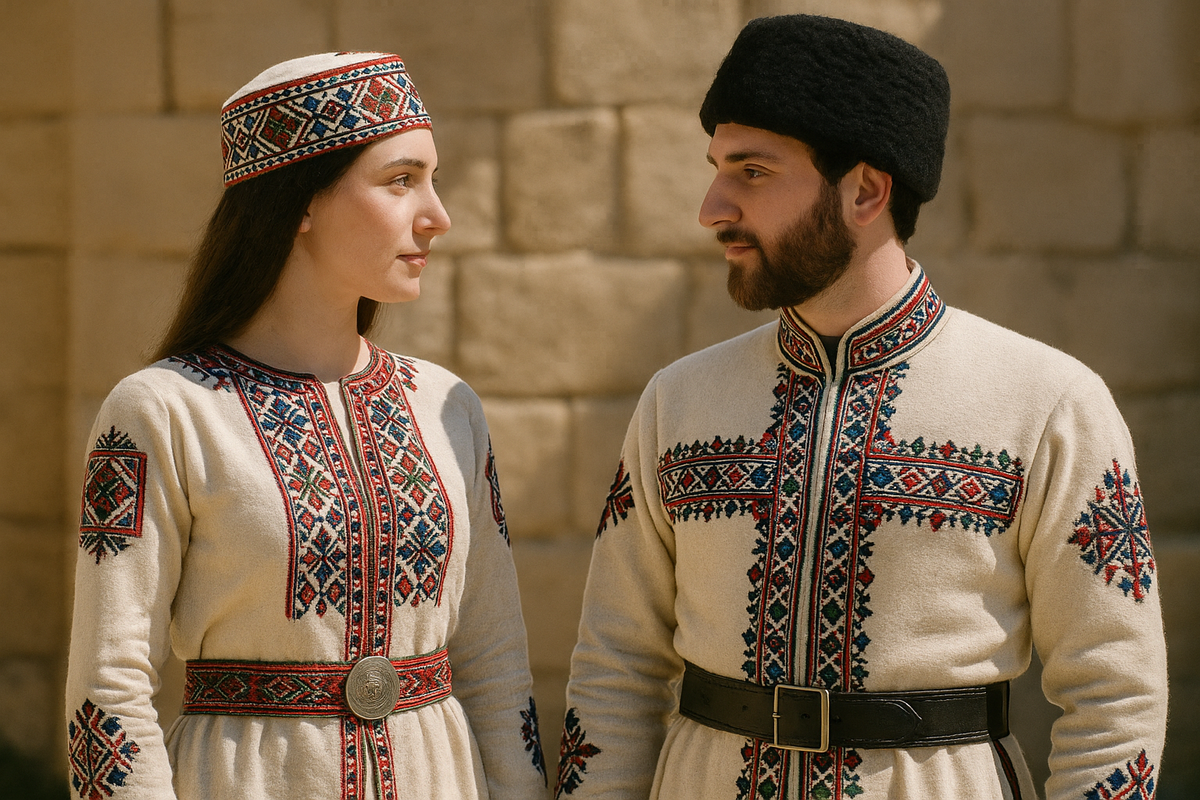
Men wore formal suits with simple embroidery on the shoulders and cuffs — a sign of military spirit and family honor. Women's clothing was distinguished by a wealth of ornaments: sleeves, chest area, aprons and headbands were especially decorated. Each detail carried a deep symbolic meaning and emphasized the status of a woman in society.
🧣 Headbands — mandilas — were a woman's "passport". The embroidery on them reflected: age, marital status, family affiliation.
🤍 White crosses were embroidered on wedding mandilas — a symbol of purity and spiritual transition to a new stage in life. It was a kind of amulet accompanying the bride in her new role.
🪢 Ornaments decorated not only clothes, but also everyday things. Embroidery was found on: pillowcases and bedspreads, towels and bags, rugs and curtains.
🎗️ Amulet belts were especially important - they were passed down from mother to daughter, from grandmother to granddaughter. They did not just support clothes, but "guarded the body and soul", protecting from the evil eye and evil words. Such belts were both a utilitarian item and a magical talisman. 🧵 Thus, the entire fabric of Khevsur life was stitched with protection, faith and beauty - from a caftan to a pillow. It is in such details that the tradition remains alive, vibrant and deeply symbolic.
🌟 Modern Revival
🎯 Khevsur embroidery officially recognized as a cultural heritage
In 2025, this unique form of decorative art received the status of intangible cultural heritage of Georgia. This is not just a formality - an important step for the preservation and development of a craft that has been passed down from generation to generation for centuries.
🏫 Thanks to this status it is now possible to:
- create craft schools and clubs,
- hold master classes and festivals,
- organize exhibitions with the participation of craftsmen and designers.
Young people have the opportunity to learn from the bearers of tradition, absorbing not only the technique, but also the worldview woven into every stitch.
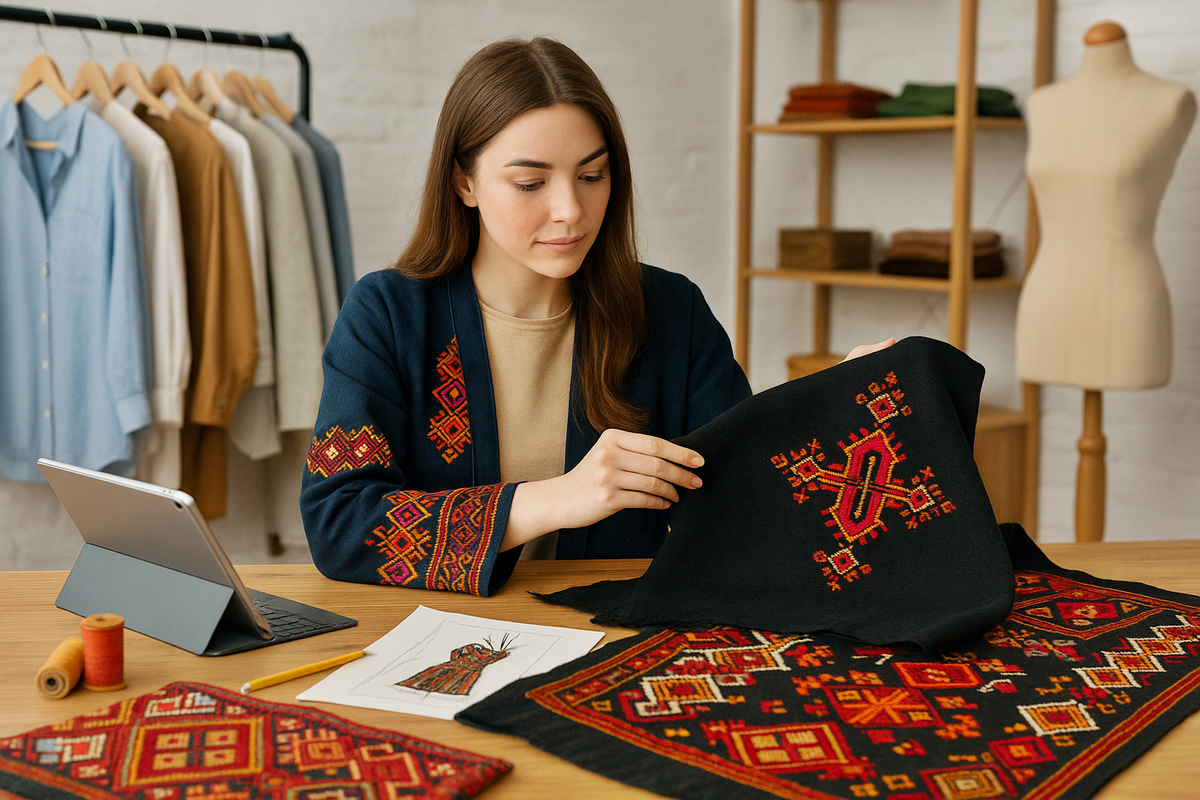
👩🎨 Modern craftswomen give the tradition a new lease of life. Artists and artisans who combine Khevsur motifs with current forms and materials are actively working in Georgia.
🌟 A striking example is Gulisa Tsiklauri. She creates: 📱 phone cases, 👜 bags and belts, 🧢 hats and accessories - all with authentic patterns. These products are popular not only with tourists, but also among designers who are inspired by embroidery for modern collections.
🧵 Khevsur embroidery is part of the “slow fashion” movement. This is not just a trend - it is a philosophy of conscious consumption. 🌿 Embroidered items are made by hand, from environmentally friendly materials, and carry a deep cultural meaning. They emphasize: individuality, connection with roots, respect for the traditions of ancestors.
🎨 Khevsur motifs today are not just souvenirs, but a fashionable and profound way of self-expression. This is how the ancient craft again becomes part of everyday life: in the city, on the catwalk, at home and on the screen.
📍 Where to see and buy
In Tbilisi, be sure to visit the Open-Air Ethnographic Museum and the National Museum of Georgia. They have a collection of original costumes, household items, and unique embroideries brought from the highland villages of Khevsureti. You will be able to see hand-made details and understand what the traditional life of the Khevsurs looked like.
🛍️ Want to take a piece of history with you? In the capital and regions, there are craft workshops and craft shops where you can buy products with real Khevsur ornaments. Particularly popular are: 🎀 amulet belts, 🎒 fabric bags, 🧢 embroidered hats, 🖼️ interior panels. Many craftsmen adapt patterns to a modern style, while preserving traditional symbols.
📦 In some centers, you can even order a custom product - with the symbol you need or in a certain color scheme. This is not only a beautiful souvenir, but also a meaningful amulet, made by hand.
🎡 Summer is the time for craft fairs and festivals. In the cities of Georgia, folk craft festivals are held, where Khevsur craftswomen demonstrate their works. You will be able to see the embroidery process live, talk to the keepers of the tradition and learn the history of each ornament. Often at such events you can buy unique things that are not on sale.
💻 And if you are not in Georgia - no problem! Many products are now available in online catalogs of national brands, on the websites of Georgian designers and in thematic online stores.
❓ Questions and Answers about Khevsurian Embroidery
💬 Yes, many artisans sell authentic pieces — from belts to pouches. Just be sure to choose handmade work, not factory replicas.
💬 Ornaments are sacred symbols — they offer protection, tell stories, and even indicate social status or rituals.
💬 Men didn’t embroider, but they wore garments with protective symbols — especially warriors. Their attire featured special “combat embroidery.”
💬 Yes, Khevsurian embroidery is the most geometric and symbolic. Unlike the floral patterns of Kartli or the vivid compositions of Kakheti.
💬 Yes, workshops are held in Tbilisi, Mtskheta, and Kazbegi — some right in the homes of artisans. It’s a great ethnic experience.
💬 Because Khevsureti was isolated for a long time, traditions were preserved without outside influence. That’s what kept the culture intact.
💬 Yes, each pattern was like a personal symbol — it could show a person’s origin and even the challenges they had faced.
💬 Symmetry is protection. It was believed that evil couldn’t pass through mirrored or closed patterns.
💬 Yes, for example, every belt is believed to guard the soul, and copying a pattern could "steal" someone’s fate. These beliefs live on.
💬 Besides museums, head to mountain villages like Shatili and Biso. In Tbilisi, check out shops in Sololaki or ethnic design exhibitions.
🧶 Khevsur embroidery is not just a craft, but a language with which the women of mountainous Georgia have been conveying their faith, strength and beauty for centuries. Each ornament contains amulets, memories and elements of an ancient worldview.
🌱 Today, this heritage comes to life in a new form: on fashion catwalks, in interiors, in souvenirs and decorative items. By supporting the masters and interest in Khevsur culture, we maintain a connection with a living past that is worthy of the future.
📩 Found a product with Khevsur embroidery in Georgia? Leave a review - and we will add this place to the catalog to tell others!

0 comments
Log in to leave a comment